Month: September 2013
“The Hostess”
Flash fiction by Nancy Stohlman
The hostess decided to throw a small dinner party, just the neighbors and a few friends, just something to lift her spirits. She made pot roasts and French Onion soup from scratch while he retreated to the basement.
There was a few weeks truce, an uneasy truce for the sake of the children, and then another all-night battle followed by a series of murder mystery parties, complete with costumes, wine tastings, realistic weapons rented by the hour, and yucca whipped into small hills as light and fluffy as French pastries.
By the end-of-summer-Hawaiian-luau, the hostess was holding back tears through her fake eyelashes and long, black wig as he moved his things into the spare bedroom: You invited them, you entertain them! he yelled, slamming the door. The guests tried to keep her glass filled with an assortment of specialty rums and freshly crushed papaya mixers.
Soon the invitations started going unanswered; the guests found excuses for not attending the 1950’s sock hop, the M*A*S*H party, the “1001 Arabian Nights” celebration complete with whole roasted goat. Come spring, the 25-foot-tall Maypole looked desolate, pastel ribbons hanging limply like unwashed hair.
But today, the sound of hammers. It would be the greatest party she had ever thrown. Everyone would come. A crew of a dozen was sawing, hammering, painting, and creating a to-scale facsimile of the Titanic. Another crew was bringing in 500-gallon tanks of water that would, at the appropriate moment, be released into the back yard, while the guests, in full pre-World War I formalwear (as specified in their invitation) would get into actual lifeboats and attempt to row themselves to the safety of the house. A caterer was reconstructing an iceberg two stories high, and, at 11:40 pm, the gong she rented would sound, the string orchestra would begin to play, the water would begin to rise and the guests would file into lifeboats, of which there would, of course, be too few.
Originally published by Pure Slush. Read original here.
 Nancy answers The Hue Questionnaire:

What is your favourite colour? Why?
Red. When I was 10 I was told by the Avon Lady that I was a “winter”
Do you wear this colour? How often and when?
As often as I possibly can. Lipstick. Boots. Red sparkles if I can get away with it.
What does the colour suggest to you?
Wonder Woman at a voodoo German sparkle party.
What does it not suggest to you?
Barfing out the window of a moving RV.
How long has it been your favourite colour?
I’m pretty sure my placenta was red.
When does it work best?
Here’s the thing: Red is both celebrity and paparazzi. When a person walks into a room embodying red, everyone secretly feels better: Red has arrived. It’s kind of like when someone brings the Hot Damn Cinnamon Schnapps to a wedding reception. Maybe you wouldn’t have done it yourself, but you’re glad to know that someone else has, and you might crowd around that person and even take a swig because it will make your story better later.
When does it not work for you?
When I want to disappear. There are plenty of days I just can’t live up to the expectations of red.
How does the colour relate to you, or you relate to it? Are you this colour or is this colour you?
At my best, I am always red.
“The Monster Opera” reviewed by Savage Reviews
-Reviewed by Ian Chung-
Following on their first flash novel, Matthew Ankeny’s The Rink, Bartleby Snopes Press is releasing a second title in the series, Nancy Stohlman’s The Monster Opera, ‘a flash novel in two acts’. Structurally, Stohlman’s work mixes operatic libretto and sheet music with production reviews, wrapped up within a self-reflexive narrative that centres on a forbidden story. Or as the writer character of Ursula Leonard announces in the ‘Overture’, regarding The Monster Opera, ‘I hate this story. I hate the Muse. […] Now it’s a bastard deformity. Not an opera, not a novel. I wish I’d never written the first word. I had no idea what kind of monster I was growing.’
 The first act of this flash novel thus consists mainly of the interactions between Ursula and the opera singers that she has come to stay with, tenor Libretto Santiago and soprano Magdalena Santiago (née Basco), as Ursula is seduced into writing their story. Libretto demands Ursula’s loyalty in exchange for giving her the story, offering her a final chance to ‘leave this place, leave [his] bed, leave this house and find [her]self another’. Right after she agrees to pay the price, the narrative interrupts to warn Libretto:
This is the final moment before the story changes hands, the moment your ego has done you in. You’re too infatuated to think straight, you find the prospect of becoming a character romantic and appealing, you want to be immortalized in words, you want to feel that your story is worth taking. Later, when it’s too late, you’ll forget that you gave it willingly. I warned you.
The story in question is akin to a living organism, casting its pall on the Santiago household, or as Ursula writes, ‘The whole family suffered from sad sickness.’ It is literally transmitted from Libretto to Ursula through a bite, continuing to gestate inside her: ‘The Forbidden Story grew inside of me. My breasts were stretched and sore. […] The story was growing stronger; it was swelling, transforming.’ It gradually becomes clear that what is being transmitted is really a poisoned chalice, in that it confers preternatural talent on those it infects, since Libretto received it from his father and went on to become the world’s greatest tenor, but ‘he [also] felt the monster stir’ inside him. In the case of Ursula, she writes, ‘The monster lives in me, wants to escape, wants to take over my body and mind.’
The final piece of the puzzle slides into place at the end of the flash novel’s first act, with the appearance of The Traitor, who also demands the deadly gift from Libretto. It is quickly revealed that The Traitor is in fact Ursula’s husband, Hugo, seemingly written into existence in the role by the Forbidden Story’s manipulation of Ursula (‘It’s growing on its own now’). In its second act, The Monster Opera shifts into a more surreal mode, as the walls between fiction and reality begin to break down, and the Forbidden Story writes itself towards a gruesome end for all involved: ‘The poet writhes and expels the story she is not allowed to write […] rotted, bloated chunks of paper that leave a strong odor.’
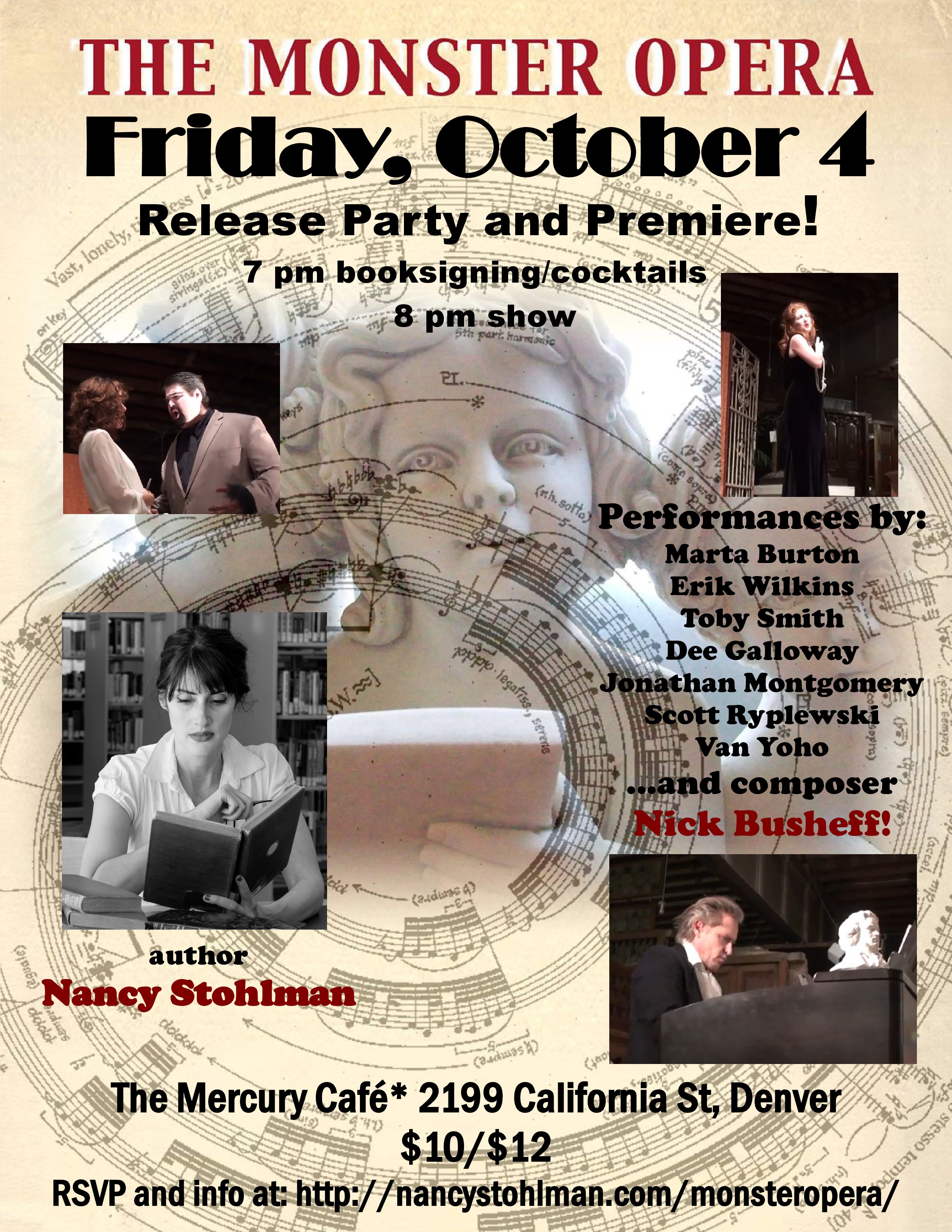
What is most fascinating about Stohlman’s work is how freely it shifts back and forth between different artistic forms, the whole package compressed into the length of a short story. Given its usage of sheet music, it would have been interesting to see an e-book produced that incorporated performances of those songs, in a similar fashion to what happens in Superbard’s The Flood. However, while Stohlman herself has acknowledged the potential of The Monster Opera as a performance piece, having done a staged reading with composer Nick Busheff and a small cast, she also sees it first and foremost as a written work. In that respect, The Monster Opera is a bold attempt to carve out a space for the flash novel as a distinct category within the fiction landscape. In doing so, the work also raises questions about how art forms like opera can sustain an existence today, as well as the sacrifices demanded of those involved in the act of creating art.
Purchase The Monster Opera on Lulu
Your Success Is Mine and Mine is Yours
 As an artist, I walk a path that has been smoothed by others. If I take an easy step, it’s because someone before me has been kind enough to move a rock out of the way. And each rock I move on my journey leaves the road a little clearer for you.
What if we all stopped and really embraced this idea for a moment? What if, instead of feeding the fear, the jealousy, the insecurity, and the competition, we wrote ourselves a new story of mutual success?
Unfortunately most of us operate from a vantage point of scarcity. Writers live in a very real world where publishing houses are folding, or merging, a gazillion books are being written and published every year, and every year we are faced with a new study about how few people read books. We’ve been conditioned to believe that by this time next year there will be only one reader left on the whole planet…and she’s dying.
So if I’m living in the scarcity paradigm, then your success is a direct threat to my own.
But what if this isn’t the only story?
We’re storytellers, after all. We are writers and artists and painters and musicians—our job is to create ideas that weren’t there before. So what if we created a new story? A story that says there are enough readers/fans/audiences for all of us?
What if we created a story that said every reader you recruit is a reader for the collective? What if every book I sell is a potential reader for you? What if, as a collaborating community, we can rebuild our dying readership and infect the world with our love of words?
If I step out of my fears, the ones that say there isn’t enough for us all, then your success can only support mine and my success is in service of yours. And like a perfect partnership we take turns: I teach, you learn. I learn, you inspire. I surprise, you applaud. I applaud, you dazzle.
We are traveling a well-worn road, and every one of us owes our successes to someone before us. In return, we share our successes with those who follow. Applause is contagious, after all, and when one of us wins, we all win.
Together, we can create a new story.
 Nancy Stohlman