“an energetic, comprehensive guide….If you like the short form, as a reader or writer, make sure Going Short is part of your must-read library.”
Readers VIews
Going Short: An Invitation to Flash Fiction (Master Class Series)
Nancy Stohlman Ad Hic Fiction (2020) ISBN: 9781912095797 Reviewed by Tammy Ruggles for Reader Views (01/2021)
“Going Short: An Invitation to Flash Fiction (Master Class Series)” by Nancy Stohlman, is an energetic, comprehensive guide that teaches writers how to write flash fiction.
Some readers like long, luxurious stories, while others like them short and sweet. Writers are no different. Some enjoy writing the long novel, while others enjoy the shorthand style of flash fiction. Some, of course, prefer to do both. If you’re a writer who’s never dabbled in flash fiction but wants to, or one who has but would like to take a deeper dive into the process and take your writing to the next level, then this book is all you really need. Stohlman takes you through the basics–what flash fiction is, what it isn’t, and what it could be when done well. Anyone can write a super short story. But does it still make an impact? Is it as entertaining and moving as if you’d written it long? This book will help you explore that and will give you hands-on instruction on how to make your flash fiction the best it can be.
We writers have all heard the advice “write tight” or “write lean.” But flash fiction is more than just being concise. It’s creating a meaningful story in a short amount of space–still satisfying. Still moving. It has nothing to do with short attention spans or a lack of time. It means you enjoy really short fiction, for its own sake.
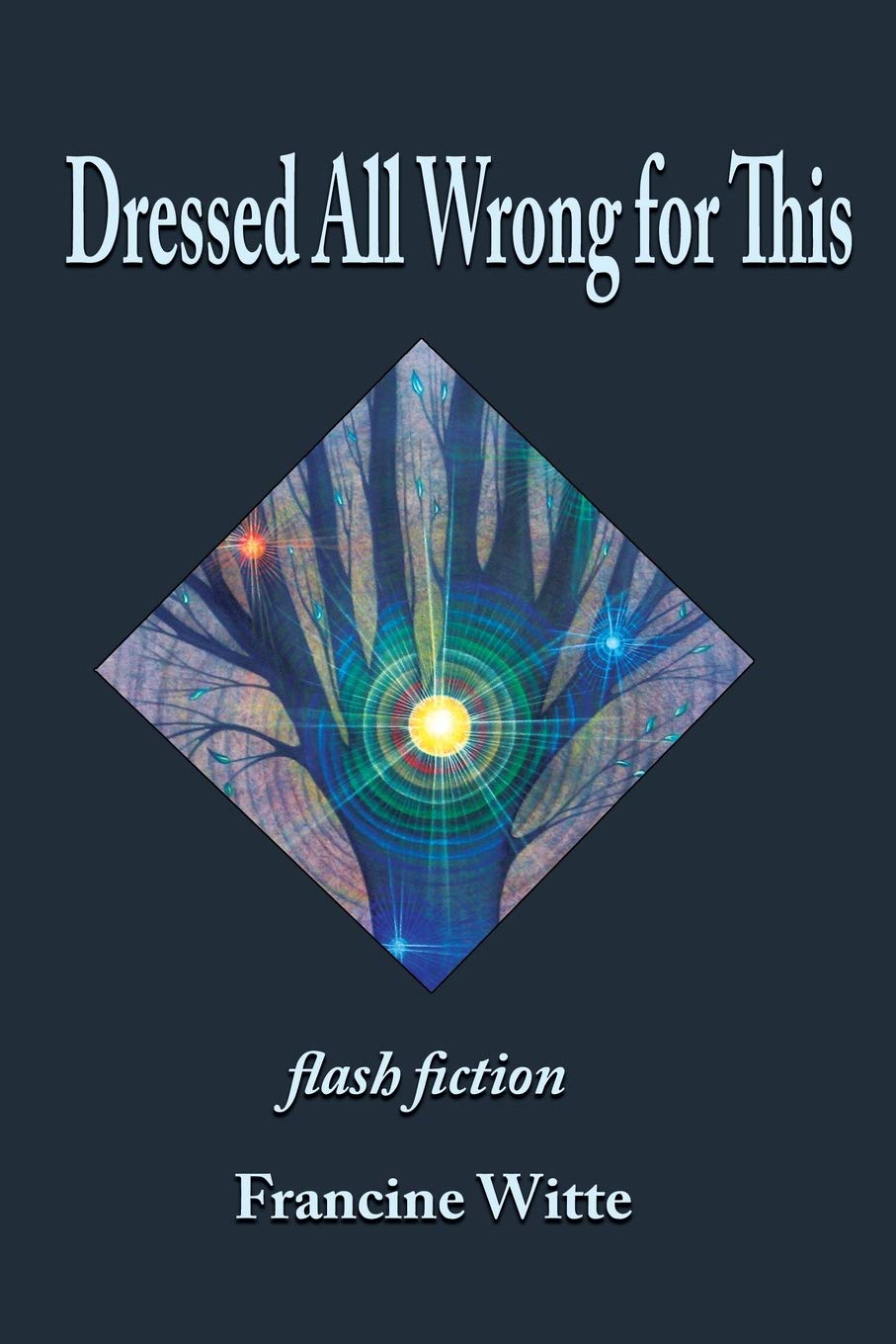
Dressed All Wrong For This, Francine Witte’s new book of flash fiction and winner of the Blue Light Fiction Award, is a smorgasbord of poignant absurdity, expertly navigating the delicate line between pure whimsy and subtle, sometimes devastating truth. This book will make you laugh at the same time it takes your breath away.
Francine Witte
Nancy Stohlman: Your work is whimsical and absurd, almost slapstick at times, just the way I like it! Where do your ideas come from?
Francine Witte: I get my titles first, for the most part. A phrase might pop into my head and I go from there. The story usually unfolds as I am writing it. I rarely know what the story is going to be about until I start. Just letting myself go where the story takes me often allows for the absurd to happen.
NS: There are so many memorable moments in these stories. This one from the story “Flag” stood out for me:
The waiter brings the Coq Au Vin.
This is chicken, Janie says
I thought it would be something more.
You might also say that about love, the waiter smiles.
This passage is the perfect example of what I love about your work—just when you think it’s pure silly, you swiftly rip away the tablecloth to reveal the truth underneath. Talk about the relationship between absurdity and truth in general and in your writing.
FW: To me, when something is absurd, it’s because it’s true. So very often as I’m thinking of writing how people are getting along in a restaurant, in love, in just about anything, I’m also thinking, what’s really true here. What aren’t the characters saying? In the above passage, it seems absurd that a waiter would just randomly say what he says, but it’s also true.
NS: There are so many recurring themes in this book, including food, betrayal, and of course, chicken. Why chicken?
FW: Betrayal is my go-to theme. It has conflict baked in. I have lots of guys leaving lots of gals for no reason, or lots of reasons. Parents cheating on each other. Friends stealing each other’s boyfriends, and on and on. It never leaves me. As to food, it seems to be what people do. They eat. Anytime people are getting together there is food. And if there isn’t food now, there is food later. And I suppose that chicken is kind of an easy food to reference, being as ubiquitous as it is in our culture. Also, I think the word “chicken” is funny.
NS: We first shared pages in Tom Hazuka’s wonderful anthology Flash Fiction Funny. Do you think comedic writing is taken less seriously in the writing world?
FW: Humor in writing certainly has less gravitas, even though it’s much more difficult to do well. Maybe humor tends to be more topical, and therefore has a specific shelf life. I love humor and absurdity is like a quieter form of humor.
NS: Talk a little about your journey to flash fiction. Did it choose you?
FW: I started as a poet, and most of my formal writing education, my MFA, etc. is in poetry. I wrote and published poems in the late ‘80’s. Then in the early ‘90’s, I ventured into playwrighting, and wrote a few full-length plays and many, many one-acts. I liked the one-acts more because I love the compression of them. Also, I liked that there are more things you could do form-wise in a short play. That’s pretty much the same as flash fiction. I started to write short-shorts (as they were referred to then) and immediately fell in love with the language and possibility of such a short story. You can set a flash on the moon, for example. That doesn’t work as well in a longer story. I took a class with the great Roberta Allen, who was the only person teaching flash in the late ‘90’s (that I’m aware of.) I started sending my stories out, and got them accepted into the print journals. And that’s how the journey happened.
NS: You are widely published in both flash fiction and poetry. How do you navigate/separate between the two? Or do they bleed into one another?
FW: Flash fiction and poetry have similarities in their language, but for me that’s where it ends. I feel like they do very separate things. Poetry is a meditation. It doesn’t need a story, and if there is a story to the poem, that story’s purpose is the speaker examining a moment and how it helps the speaker learn something. Poetry has an inward movement. Flash fiction, on the other hand, is the unfolding of events that the narrator is living in that moment. The narrator is in a state of discovery as the story goes on. An outer movement.
I always know what I am going to be writing when I sit down and have never wondered if a flash fiction should be a poem or vice versa.
NS: Dressed All Wrong for This was the winner of 2019 Blue Light Book Award: congratulations! How important do you think awards are for writing careers?
FW: Thank you. For me, awards have been important as three of my chapbooks got published as part of a prize. Often, contests are the only avenue to book publication. It’s also nice to get the recognition. I don’t know how important it is to one’s career. I think it’s more of a nice thing than a necessary thing.
NS: What’s it been like to be a writer in New York City during the year 2020?
FW: There is such a vibrant writing scene in New York City. In fact, many writing scenes. Downtown, universities, etc. You could go to a reading every night. Sometimes two. So, the closure of these readings made a significant dent in the networking and socializing aspect. Also the promotion aspect was affected. People who had a book launch in 2020 were kind of screwed. But I don’t think these limitations are distinct to New York. I do shudder, however, to think what we would do without zoom. Online readings have enabled worldwide connections that would have been otherwise impossible. So, while we missed out on in-person readings, a whole other kind of reading, the online reading, was born. Talk about lemonade.
NS: Lemonade indeed! Advice to someone writing a book?
FW: I can only speak to books of flash and poetry. I would say to write and publish the pieces and let the book come together from that. I’ve never sat down to “write a book.” Rather, I put all my favorite poems or stories together. I would find a way for them to tell a story, because usually they did. I do have a novella, The Way of the Wind, but I wrote it as if I were writing flash stories that had a plot tying them together. Most important thing – every story or poem should be a 10 (at least to you.)
NS: “Every story should be a 10.” I love that because, yes, we do get attached to our darlings. Thank you so much for hanging out with me, Francine! Can you share some links to book and other promo links?
Poetry books, Café Crazy and The Theory of Flesh available on Amazon
Flashboulevard.wordpress.com (a web journal of flash that I edit)
Follow her on twitter @francinewitte
Francine Witte’s poetry and fiction have appeared in Smokelong Quarterly, Wigleaf, Mid-American Review, Passages North, and many others. Her latest books are Dressed All Wrong for This (Blue Light Press,) The Way of the Wind (AdHoc fiction,) and (The Theory of Flesh.) Her chapbook, The Cake, The Smoke, The Moon (flash fiction) will be published by ELJ September, 2021. She lives in NYC.
“Flash fiction is our David against the Goliath of literary tradition.”
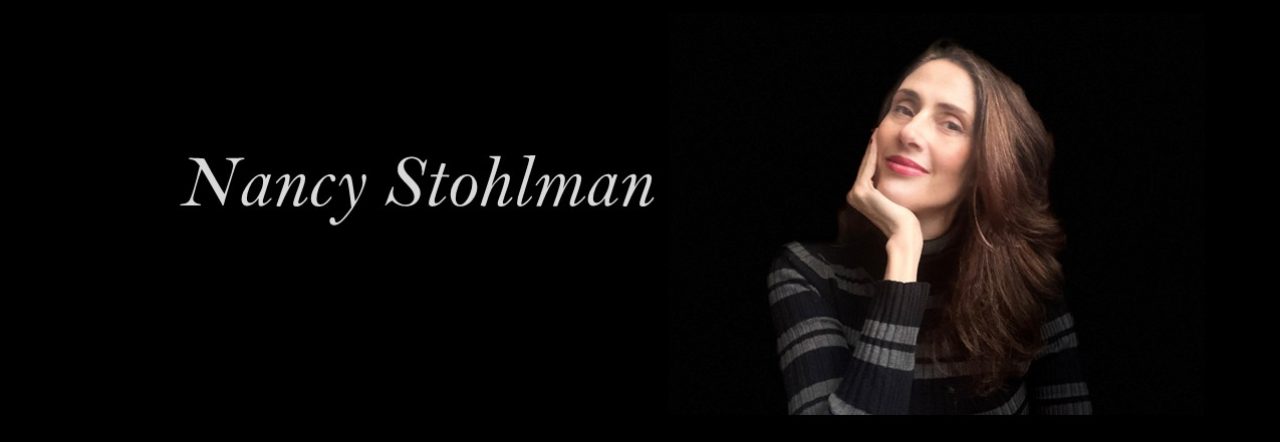
Nancy Stohlman
What’s the hardest lesson you’ve learned from being an educator?
I love watching writers fall in love with form. The hardest part is trying to explain and champion the genre to outsiders who are often reticent or suspicious. I often get dismissive reactions, “readers-have-short-attention-spans” or “flash-isn’t-serious-literature.”
Flash fiction is our David against the Goliath of literary tradition.
How important is emotional maturity in writing good flash?
All the rules of good writing also apply to flash. Often I see emotional maturity manifesting as wisdom to know what the story wants from you vs. what you want from the story. Word constraint forces you to get really clear. We are midwives of the story and should be in service of the story–what I would call true creative maturity. This is also where poetry and flash fiction meet—the distillation process requires us to sometimes “write” hundreds of pages to accurately distill one small truth.
Writers compare their successes and failures to others’. How do you deal with other writers’ success and failure? What advice would you give a beginning writer who does such comparing?
I see others’ successes as inspiration for my own. But some days I can’t. For all of us there can be hard days, weeks, or seasons, and it’s okay to be gentle with yourself on hard days. Try to take the big-picture view and remember we’re all in different phases of creative process. For instance, I get to enjoy watching my book Going Short finally go into the world. But I’ve worked on it behind the scenes for seven years, and I’ve published very little in the last year. It’s a rhythm.
Christopher Bowen is the author of the chapbook We Were Giants, the novella When I Return to You, I Will Be Unfed, and the non-fiction Debt. He was a semi-finalist in the 2017 Faulkner-Wisdom Novella Competition and honorable mention in the 45th New Millennium Writing Awards in the non-fiction category. He blogs from Burning River.
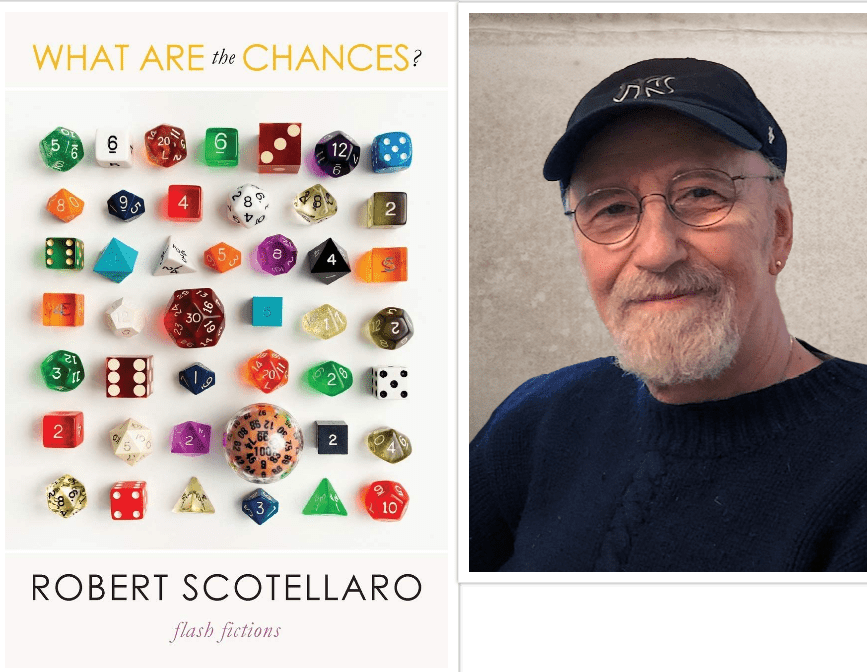
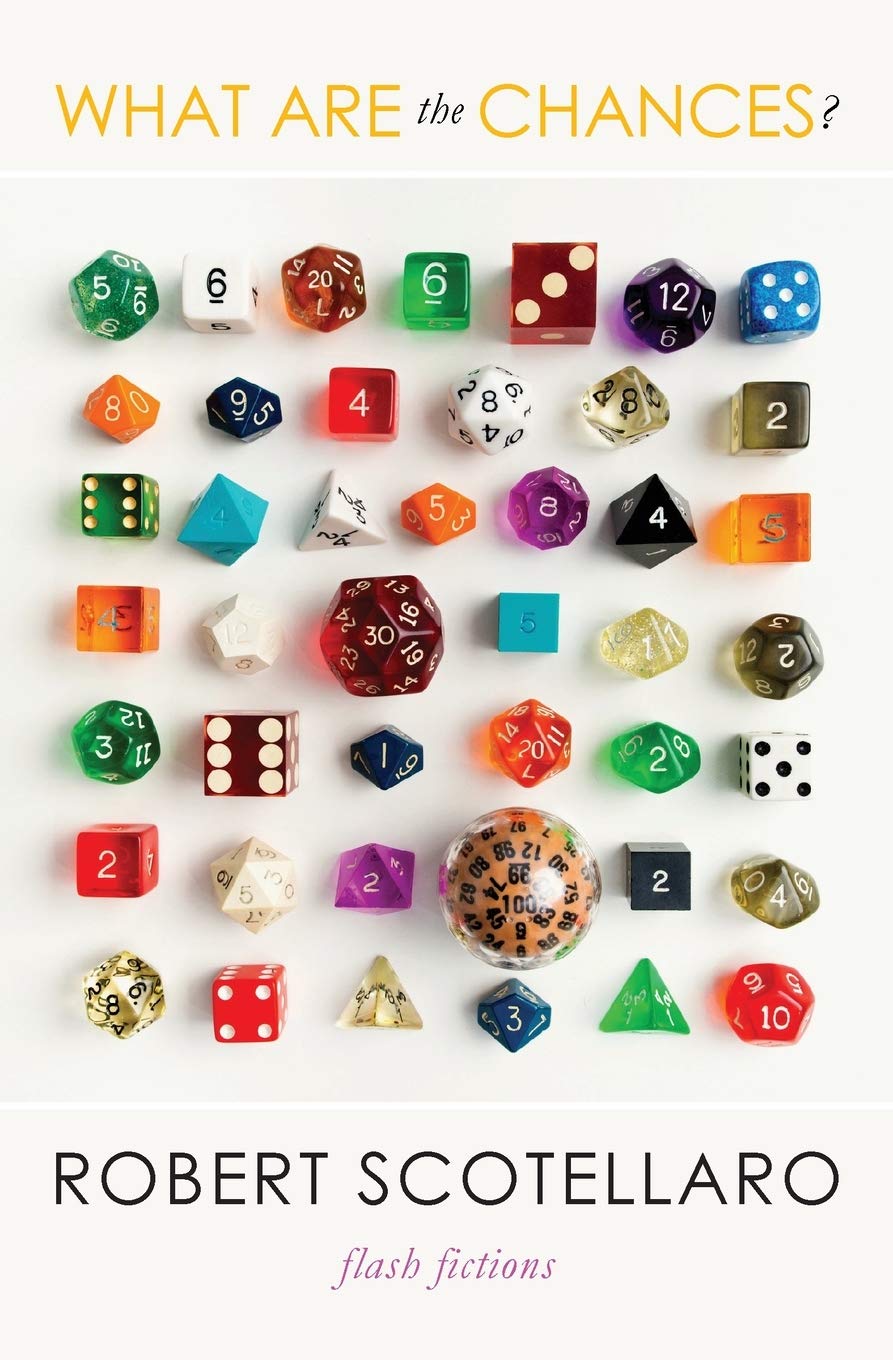
Robert Scotellaro has been a treasure of the flash fiction community for many years. Back in 2015 I said of his work, “Scotellaro demonstrates that the more we understand our stories, the less we have to explain them. Often the journey of an artist is a journey of learning what to leave out: Rothko’s complex surrealism eventually matures into single or double colored canvases; Picasso’s realistic drawings mature into simple thick lines and shapes—and writers such as Scotellaro say even more with even less… His work takes the leap into mastery, zooming in on the subtle moment at hand and letting that one drop of water tell the story of the entire world.” Now, with the release of his new collection, What Are the Chances? we get the opportunity to take another step on this journey with him.
Author Robert Scotellaro
Nancy Stohlman: Welcome, Scotty! First, and in the spirit of flash fiction, describe this book in 6 words:
Robert Scotellaro:Flash exploring the vagaries of “chance.”
NS: You are widely considered a master of flash fiction, and deservedly so. Talk a bit about how you found the form—or did it find you?
RS: Thank you, Nancy. I think the form found me. I was always innately drawn to brevity in literature: poetry, the short story, flash and micro fiction. Reading the work of Emily Dickenson as a teenager opened me to a level of compaction that (ironically) seemed borderless in its ability to express the intimate doings of inner and outer worlds with such clarity, emotion, philosophical sensibility, and power. That was an early eye-opener.
So I started out as a poet. In the seventies I also wrote fiction (including a short novel in 1971) that incorporated what I called “segments”—what now might be considered microfiction. It was surreal and reflected the times. (A joint prior to reading was required.) Most of the full-length stories I wrote subsequently were comprised of those “segments.” It was natural for me to write that way. I guess I was always a sprinter rather than a marathon runner in terms of lit.
After a time I was writing short-short stories regularly. When I discovered the anthology Sudden Fiction by James Thomas and Robert Shapard I was elated. The very short form was being showcased (taken out of the shadows of “filler” status in magazines). Then came the iconic anthology: Flash Fiction (72 Very Short Stories)by James and Denise Thomas and Tom Hazuka, and many such books by W. W. Norton were to follow.
In 2018 I went full circle and Norton published New Micro: Exceptionally Short Fiction, an anthology co-edited by James Thomas and myself. I remain as excited as ever about exploring the limitless potential of the genre.
NS: What are the Chances? is very cinematic—in fact I read all your stories almost as if they are mini movies. Does that description resonate with you?
RS: It does. I think many of the stories I write are not so much language pieces, but rather characters interacting in various settings and situations which lend themselves to those visual possibilities. Scanning What Are the Chances? one finds characters in a hot tub, an Uber car, a commune, a cave, on a fire escape, a carousel, in a subway car, behind a rectory… I view the stories in that cinematic way as I’m writing them.
Plus I like creating different characters (delineating them) and letting them interact on their own, as opposed to an “author-recounting.” Perhaps this adds to that cinematic element in my work.
NS: In the title story, “What Are the Chances?” there are two techniques that I love: the deliberate use of repetition and the way you strategically manipulate your title. Can you let us in on some of your other “masterclass” writing techniques, particularly around flash fiction?
RS: I’d like to do more stories using various refrains in that manner. They create a kind of rhythm, a word-tumble of sorts, to the finish line.
Far as titles (I almost always) don’t think of them until a story is completed. In the case of the title story: “What Are the Chances? I was taken with how timing, chance, and random happenstance can alter a life/lives, and that all of these elements were contained within that piece. I felt this title served the collection, highlighting that occasional theme which runs through it as connective tissue.
Not sure about the “masterclass” part, but what I feel is essential to writing flash, is the “telling detail” (replete with implication). Perhaps several that create an allusion to something bigger— more at stake upon reflection—after the last word is read, providing a kind of lingering resonance.
NS: Yes, “refrains” is the right word, I think. For example, in Nothing Is Ever One Thing published earlier this year from Blue Light Press, you have a series of “Micro-Fables” that thread through the other stories. Love this idea—can you talk about the inspiration?
RS: With Nothing Is Ever One Thing I wanted to “mix things up” a bit, bend/blend genres. There are also four “P.S.” stories throughout. I sought to incorporate lots of tempo/tone shifts. The micro-fables are prose poems—microfiction’s kissing cousin. I am, at this point in my career, fascinated with the notion of investigating form. Forms within the very short form. I have a chapbook’s-worth of such stories recently completed and a full-length manuscript I’m finishing up devoted to “like” forms. And I’m finding infinite possibilities for variety within them. I’m pretty excited about this new direction.
NS: As soon as I read “Mr. Nasty” (in What Are the Chances) I had a flashback: I chose (and loved!) this story for a Fast Forward anthology over a decade ago! My, how time flies. Which goes to say you’ve been writing flash fiction for a long time. Tell me: How has it changed in the last decade or more?
RS: I liken it to a music concert where a performer plays new tunes, but adds a dash of “oldies” that have stood the test of time. That mix well.
Fast Forward was a terrific venue for flash. I think I published four or five pieces in various volumes. If I’m not mistaken your co-editor, Kona Morris, read “Mr. Nasty” on a Colorado radio station. You all contributed so much to short form lit with those anthologies.
Far as changes—good lord!—so much has evolved with the genre since then in terms of popularity, expansion, and status. Flash fictionis no long consigned that “sub-genre” category. It is its own genre now. Officially. Standing on strong legs. Now you can hardly find a magazine (including the major ones with The New Yorker on the list) that don’t publish flash. And there are a plethora of personal collections by outstanding authors continually finding their way to print. There are important anthologies by W. W. Norton and many others in America as well as internationally. And now there is even a significant Flash Fiction Collection housed at the Ransom Center at the University of Texas, Austin. Flash is thriving.
NS: Which leads to the exclamation of wonder that you published not one but TWO books in 2020, a year in which publishing has been challenged like everything else. Can you talk about how these two books are different/complementary to your oeuvre?
RS: Actually Nothing Is Ever One Thing was published in 2019. What Are the Chances? was accepted in 2019 as well, but Kevin Morgan Watson at Press 53 didn’t want them bumping heads (promotion wise) in the same year, so we waited for a 2020 pub date.
I think both collections tread that territory between misplaced intentions and a quest for connection, solace, and redemption, with humor/irony close enough at hand to grab onto. Uncertainty, of one sort or another, is perhaps the biggest thing that trips us up. I like exploring that, and how we stumble or correct to find peace with it.
Nothing Is Ever One Thing is more experimental because of the genre shifts (prose/prose poetry). However, with What Are the Chances? I’ve welcomed examining challenging subjects (still at a slant) and in a variety of ways.
I think Kevin was right about waiting. It’s allowed each collection to breathe a bit.
NS: I agree. What’s it been like to publish a book in the Year of Our Lord 2020?
It’s been a sweet counterbalance to these dark times. I so miss the hugs of friends at readings, other gatherings, my daughter many states away, dinners out… But it was so great working with Kevin at Press 53 and his editor, Claire Foxx, on this book and with Diane Frank at Blue Light Press before that, with my previous collection in more stable times. I’m so grateful.
NS: Advice for writers working on a book?
RS: When you have enough stories for a collection to assemble, see which of them rub together in interesting ways. Sometimes similar themes side by side with fresh approaches work well. Sometimes it’s tempo shifts that are more interesting. Read the stories out loud. Sometimes that clanking sound in the machinery is what makes the movement more compelling. Sometimes it’s the smooth purr of words you’re after. Don’t look over your shoulder. It’s important to make the process as organic as possible, maybe even fun. Finding a publisher is something else entirely. Too bad there isn’t something like a dating service for publishers and writers. You’d probably learn all you needed to after the first drink.
NS: That is perfect advice. And I love the publishing dating service! Anything else you want to add?
RS: In terms of writing that book/those stories: show up!Be bold! Writing is all about mystery and discovery. Never let the blank page or screen intimidate you. You cannot have the reward of discovery without the mystery.
NS: And this is why you are a master. It’s been such a pleasure getting to pick your brain! Can you share the links to the book/books and other promo links.
Robert Scotellaro has published widely in national and international books, journals and anthologies, including W.W. Norton’s Flash Fiction International, NANO Fiction, Gargoyle, New Flash Fiction Review, Matter Press, The Laurel Review, and many others. His stories were included in Best Small Fictions (2016 and 2017) and Best Microfiction 2020. He is the author of seven literary chapbooks, several books for children, and five full-length story collections: Measuring the Distance, What We Know So Far (winner of The 2015 Blue Light Book Award), Bad Motel, Nothing Is Ever One Thing, and What Are the Chances? He was the recipient of Zone 3’s Rainmaker Award in Poetry. He has edited, along with James Thomas, New Micro: Exceptionally Short Fiction published by W.W. Norton & Company. He is one of the founding donors to The Ransom Flash Fiction Collection at the University of Texas, Austin. Robert lives with his wife in San Francisco. Find him online at: www.robertscotellaro.com



 Nancy Stohlman