So… this month I decided to scrap my original post and share something very personal instead, particularly how this experience is framing the current situation for me. Indulge me a moment…
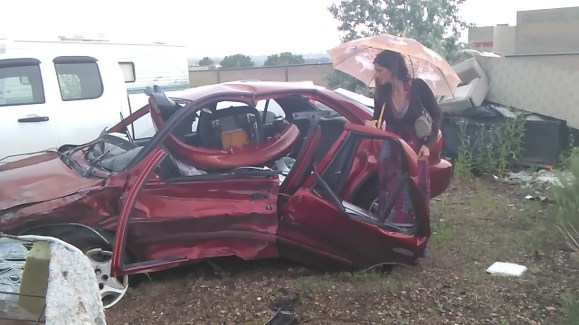
Almost 4 years ago I was in a car accident on my way to a reading. “In a car accident” isn’t quite right; I was hit head on by a drunk driver going 60 mph the wrong way on a 3-lane highway in broad daylight. And almost as soon as it was over, from the moment I was ripped out of the car, then in the ambulance, and then in the ER, I heard one thing over and over: you are so lucky.
You. Are. So. Lucky.
The first responders were amazed that my back wasn’t broken. The doctors, nurses, even later the tow truck driver who dragged my carcass of a car off the highway were amazed that I was still alive at all, let alone not paralyzed or permanently injured.
I kept hearing lucky, lucky, lucky. You are so lucky you should buy a lottery ticket.
And it clicked for me in the ER, while they were pulling chunks of glass out of my skin and hooking me up to morphine. I was lucky. I’d been given a great gift. And this was a glorious day to be alive.
This story could have gone another way. Not just the way of my demise, of course, but at that precipice between light and dark I could have turned to the dark. In that space between lucky and unlucky I could have allowed myself to become a victim–because I was a victim. I’d been driving sober, doing the speed limit, wearing my seat belt. I’d done everything right—so why did this bad thing happen to me? I couldn’t teach my classes, I couldn’t get out of bed. I even missed my oldest child’s high school graduation. And I didn’t deserve any of it!
During these days of uncertainty, I’ve been thinking a lot about those lessons of 4 years ago. Coronavirus has hit the planet like an out of control drunk driver going the wrong way on the highway, and we’ve all been part of the 7-billion car pile up in its wake. Everyone’s plans just got hijacked, and it’s not our fault.
But, individually and collectively, we are now on the precipice between light and dark. Will I become hardened, bitter, angry, victimized—this isn’t fair. I didn’t deserve it. Because it’s not fair and you didn’t deserve it. The fall out is real. We got hit. The car is totaled. Our lung is punctured, half our ribs are shattered, and our arm is going to need to be pinned back together with screws.
So here’s the point of my story: One night when I was in the hospital I vividly remember when a nurse (angel) I’d never seen before answered one of my late night calls for help. He had caught me at a bad moment, in pain, frustrated because I couldn’t go to the bathroom alone, and having a bit of a breakdown. And I vividly remember he looked at me right in the eyes and gently said:
“An accident is a reminder to be grateful for every little thing in your life.”
Now, whenever I’m in uncertainly, I always try to remember: An accident is a reminder to be grateful for every little thing in your life. And this worldwide “accident” will affect people differently; none of us will emerge untouched. But bad days don’t have to become bad seasons, bad years. In times of crisis, confusion, and change we always have a choice between the dark and the light. The alchemy of this moment has the power to transform either way—the heat of this fire will scorch and burn us up or strengthen us, like pottery in a kiln. We can become victims to circumstance or we can shine no matter what.
Right now I’m grateful to be quarantined in a country where I have clean, running, hot and cold water, a pantry and a freezer full of food, a heated apartment, internet access. I’m grateful to still have an (now) online version of my job and the tools to make it happen (the kids in my friend’s elementary class in New Mexico can’t afford computers to do online school). I’m grateful that it’s spring and that I have a body that still works, a bicycle with full tires. I’m grateful that being out of toilet paper is truly not the end of the world. And I’m grateful for every one of you and for the strange but glorious creativity happening in this unexpected time.
I am sending you lots of love in such a difficult and uncertain time. I’ve been thinking a lot about the painter, Mark Rothko, who said that abstract expressionism really came as a result of artists needing to say something that had never been said before. Basically, when the world changes, art changes.
So in all this uncertainly, there is something you can do: make art. The world needs artists more than ever in times of crisis. We are the visionaries. I’ve always said that I have no idea how the non-artists in the world handle their emotions! If I couldn’t journal, write, sing…I don’t know what I would do. We are lucky. We have our art.
So to that effect, Kathy Fish and I are going to do a morale-boosting, free 30-day FlashNano-like event starting tomorrow, Monday, March 16, for everyone sitting home in front of their computers and ready to write. We’ll be posting daily prompts (many recycled from FlashNanos of years past or from our retreat “prompt envelope”) on our website (no need to sign up for anything, we are just going to keep it simple), so we hope that this strange time can also be productive and inspiring.
We can’t control the crisis but we CAN control what we do. So let’s make some art. Please be safe and stay healthy and look after each other.
xoxoxo
Michael Loveday’s debut novella-in-flash, Three Men on the Edge, is a story in three movements, a triptych of liminal spaces that forces the reader to consider the interior landscapes of others and how rarely we intersect with or even understand the tortured lives of our nearest neighbors, friends, strangers.
Nancy Stohlman: In the spirit of flash fiction, describe this book in six words:
Michael Loveday: “For sale. Crazy muse. Never porn.” (that’s Hemingway, right?)
NS: Ahem–of course (wink)! Now your bio says that you are “inspired by his experiences of an in-between place.” Explain. Do you think we are all living in in-between places in some form or another?
ML: The specific inspiration for ‘Three Men on the Edge’ was the weird hinterland between northwest London and the Hertfordshire countryside where I lived for ten years – an urban-rural “edgeland” that became the setting for the book. These kinds of places (neither fully city nor countryside) are quite a common phenomenon in 21st century capitalism, certainly in the West (and of course have been so for a while).
But it’s true I was interested in liminal states in an emotional and abstract sense too. The geographical edgeland is a backdrop for describing those.
I guess in some sense this human experience is always one of “becoming”, as much as we might crave it to be only one of “being”. The more the pace of the world seems to speed up through cultural and technological change, the more we always seem to be hurtling towards some other way of living.
NS: I read this almost like the three movements of a symphony with a fast-slow-fast movement. Talk about your organizational choices?
ML: Yes I guess you’re right. I knew I had three separate but related sequences of short prose pieces, adding up to a kind of triptych, all linked by the shared setting (and certain shared themes about relationships and mental health).
Originally I had the middle sequence (‘The Invisible World’) as the last one. It stood out as different – more meditative, more descriptive, closer to prose poems, and as much about the watery landscape of the canals and lakes of Rickmansworth as it is about a person. I thought, naively, it would be a more substantial way to end the book. But it was just sort of dangling out there as a third limb.
It was my wife who suggested putting this section in the middle. She was so obviously right! With the new order, there was a sense of symmetry, the energy picked up again in the final third, the mood became (slightly!) more comic again, and the pieces more character-driven once again. It also created the pattern that the main protagonists became progressively younger in age through the course of the book.
NS: I find it interesting that all three of the men in here are defined in some way by the women in their lives—loveless marriage, dead wife, fantasy woman. Comment.
ML: Yep, and I’d argue they’re defined by a need for non-sexual female companionship too. Women have been influential, stabilising influences in my own life and the book was intended as an exploration of what can happen to men if they aren’t connected in a healthy way to women, or to the feminine principle in general. I think it’s a big problem in some parts of our culture.
NS: You have super detailed eye to nature, especially in the second movement (Gus). Are you a secret botanist or gardener?
ML: Oh gosh I’m terrible! I never know the names for anything and am always wondering “what the hell type of plant is that?” If I had more time I’d definitely do a course of study in it. The book was a deliberate act of witnessing in terms of the local landscape, but I had to work with terms and concepts that were fairly familiar to my suburban soul. Eco-fiction for the suburbs?
NS: All three of these men are living lives of “quiet desperation” as Thoreau would say. It makes me wonder (and this has been a topic of conversation in wider circles): do you think we talk enough about men’s darkest emotions and weaknesses?
ML: There’s been improvement but I think there’s so much further we could go as a society. When I had my own struggles with my mental health starting in the mid-90s I had no preparation for it, no vocabulary or language or comfort with the territory. I was very aware of the fact that I was embarking into terrain that would mean I lost connection with some of my “closest” male friends. And I did. Not with all, but with some.
Things have got better in general since then, at least for the broad majority I think, in terms of awareness, understanding and acceptance of mental health issues. But we can go further. So many men are carrying profound wounds that are unexplored or unexpressed and just get acted out – in violence, aggression, intimidation, ruthlessness, lust for power, competitiveness, lack of empathy, problematic relationships etc. There are examples at the very top of our social food chain in both the US and the UK!
I’m very interested in the idea, from Jung, that we all need to come to terms with the feminine and masculine impulses within us, anima and animus as Jung put it, reconcile them and learn to express them healthily. I’m still working on this! (And when I’ve figured it out that’ll probably be the death of me as a writer! Haha).
NS: Your stories share locations—Bury Lake, Our Lady Help of Christians, etc. In Part 1, Denholm is even making a town diorama, which seems very telling. How does the shared location—or even just the location itself—facilitate these stories?
ML: My experience of this particular suburban “edgeland” was that I had very ambivalent feelings about living there – I felt like I was neither in London nor in the countryside, neither belonging nor not belonging, geographically on the margins, with something very significant glimpsed further off.
The physical experience of the landscape was the foundation for being between states emotionally too. I had this idea that “edgeland” locations might be sites for ambivalent, transitional, liminal experiences in fiction or poetry. (And it’s true – it’s reflected in films and TV, for example, when so many acts of transgression or secretive (often criminal!) acts take place on run-down industrial estates or in neglected woods or in empty warehouses out on the edge of town).
Rickmansworth is in the Three Rivers District of Hertfordshire, a valley where the Gade, Chess and Colne rivers converge (and feed into the Grand Union Canal between London and Birmingham). The manuscript began (as my MA dissertation) as something called “Three Rivers, Rickmansworth”, with the idea that each of the three third-person voices was a different “river”. So landscape and geography were feeding into it from the start.
NS: The three men’s stories don’t overtly overlap but they pass by one another, almost “pass the baton” from one to the next. This is one of those clever tricks that the flash novella form allows us to do. Talk about the form and how it informed the way you told these stories?
ML: Oh gosh. I could bore people for days about the novella-in-flash! Working on ‘Three Men on the Edge’ kindled what i think is going to be a lifelong love affair with the form. I’ve since written essays about it for SmokeLong Quarterly [http://www.smokelong.com/strange-feasts-and-where-to-find-them-twelve-more-great-flash-fiction-novels-novellas-part-iii/] and been lucky enough to judge the Bath Flash Fiction Award Novella-in-Flash competition for the past couple of years.
As I developed the book, I did a lot of research, exploring examples and “permission-givers” that might inspire me and influence me. There are so many great examples of novellas-in-flash or “flash novels” out there – your own included. I was conscious of the fact that I wanted ‘Three Men on the Edge’ to add something new to the conversation, so I tried to make it as close to prose poetry as the form could bear and use the structure of three related “mini-novellas” set in the same location.
I knew some readers who were looking for a stronger sense of plot might struggle with the book – there are other novellas-in-flash that have a much more explicit narrative arc, like a traditional novel has. But I hoped that other readers, perhaps ones who separately enjoyed reading poetry, might find it an interesting and unusual way of reading fiction, one where you’re asked to fill in lots of “gaps” – a suggestion of narrative rather than an actual narrative.
NS: This is your first book of prose, and it was shortlisted for the Saboteur Awards—congrats! Talk about your path to publication.
ML: Thanks! I spent a long time struggling with the project. It was hard writing three mini-novellas at once, especially when I hadn’t written fiction before. I could really have done with a mentor, but I didn’t think I could afford to pay for one, and I didn’t dare inflict all my drafts on my friends – I drafted well over 200 stories for it from 2011 to 2017, although only 64 made it into the final manuscript.
A writer who read one late draft (not far off the final manuscript – about 25 pages short of the final version) suggested I send it to her publisher. That was around December 2016. I got my hopes up, as a result, and was gutted when it was rejected – the publisher was planning a transition into an “even more experimental” direction, they said.
But ultimately that nudged me to do some more editing and add some more stories to beef up the manuscript – I basically rediscovered a number of stories that I’d written but abandoned over the previous few years of editing, and I couldn’t understand why I’d overlooked them. It was weird encountering them again – like someone else had written them. But the manuscript was better off for including them. I’m now relieved that that earlier version didn’t get published.
In the meantime, I’d read a couple of V. Press flash fiction pamphlets and liked them very much. Because of the hybrid nature of the manuscript, I knew I wanted to send it to a publishing house that dealt with poetry as well as fiction, as V. Press does. So when their submissions window opened again (for pamphlets) in the late summer 2017, I sent a very tentative enquiry about the possibility of them doing a full-length book. Thankfully, they were willing to consider it, although they had only done them for poetry before. I was still writing a few more stories after the manuscript was accepted (and in fact some that I really wanted to include were written too late for the publisher to agree to include them. They very gently suggested it was time to stop writing the book. Haha).
NS: Advice for writers who are writing a novella-in-flash or other book?
ML: Well, maybe don’t try writing three at once! Be patient, read lots of published writing, keep editing, seek feedback. If you can publish parts of it (if perhaps it’s a story collection or poetry collection) as you go along, then do so, it will give you – and a publisher – necessary belief in the book. Lastly, be protective of your baby and don’t rush it into the world. There are so many books already out there.
NS: Anything else you want to add?
ML: If you’re reading this blog and enjoy flash fiction, why not come to the Flash Fiction Festival in the UK – it’s in Bristol in the summer each year – June 19-21st in 2020. It’s an amazing, inspiring event, very welcoming and full of writerly camaraderie. Nancy and I will both be there teaching two workshops on the flash novel / novella-in-flash. And there are dozens of other brilliant workshops to choose from. https://www.flashfictionfestival.com/
NS: I second that! Thanks so much for playing, Michael!
ML: Thank you, Nancy, for inviting me to think about these interesting questions!
Links to buy the book and other promo links:
Here I am reading “Three Men on the Edge” while in Mexico…
Michael Loveday’s novella-in-flash Three Men on the Edge (V. Press, 2018) was shortlisted for the 2019 Saboteur Award for Best Novella. He also writes poetry, with a pamphlet He Said / She Said published by HappenStance Press (2011). He specialises as an editor for novellas-in-flash: https://novella-in-flash.com/. Other info about his writing, editing and mentoring can be found at https://michaelloveday.com/ When he’s not found holed up in cafés in Bath, United Kingdom, reading manuscripts or doing his own writing, Michael enjoys the usual distractions of music, cinema, and countryside walks. He has a soft spot for very earnest songs by Bruce Springsteen.
I was inspired to address this issue after I read multiple social media posts, all from writers I admire, all lamenting that they “weren’t writing.”
Not writing is painful. Unfinished work sitting there is painful. You might beat yourself up with a bunch of “shoulds” and berate your lack of discipline. It can make you feel hopeless, drained of energy and questioning if it’s even worth it. No wonder you keep avoiding it!
But there are usually some very good reasons why you’re avoiding your work. To start with, you’re a better writer now. Just do the math: if you started even one year ago, then you’re a better writer now. And that’s a good thing! That’s the beauty of practice paying off. But it can also feel frustrating when you realize that first story or first draft, the one you labored over, might have made you a better writer but isn’t at your level anymore.
Or you’re in a different emotional place. Often the impetus that drove us to the page resolves or fades; whatever we were grappling with has been settled. Perhaps we’re on the other side of a life change, and the early writing was part of our process, but now we aren’t “feeling it.”
Or you’re overly loyal to your original vision. After all, you’ve probably put in countless hours of work. But sometimes we become too attached to our original vision; sometimes we’ve read and reread our sentences so many times we can’t imagine them any other way. And when we can’t imagine new possibilities for our work, when everything is known and nothing unknown…well, then it’s no wonder we’re not writing.
And, finally, you might be shifting gears. This almost always happens to me after finishing a big project. After a book for instance, I like to consider myself creatively postpartum, recovering from the birth and taking care of the new baby for at least 6-12 months. Anything I try to write in that time will end up sounding exactly like what I was writing before because I haven’t shifted gears, yet.
But it’s discouraging, regardless of the reason, to find yourself fallow, quiet.
So what to do?
1.Give yourself a break. The creative process ebbs and flows, and what goes up must go down…and back up again. Trust the process.
2. Read. I especially like to reread favorite books in these periods. Sink into the familiar and remember why you love words.
3: Remember: creation is ultimately play. Get silly and messy and re-discover what is joyful. Be curious. Be ridiculous. Be shameless. Take a bold risk into new territory and allow yourself to fail. Remember: no one has to know.
Love, Nancy xoxo
*excerpted from Going Short: An Invitation to Flash Fiction coming this summer