Launching Your Book Into the World

LAUNCHING YOUR BOOK INTO THE WORLD

Individualized Coaching To Help Your Work Succeed!

spotlight (1)You wrote the book…so you’re done, right? Wrong. Whether you are self-publishing, traditional publishing, or still undecided, today’s market requires that writers build and sustain their own readership. But how? Who are your readers? Who needs your book? And how do you find them? Personalized coaching can help you uncover blocks to self-promotion, give you practical skills to approaching the market as a professional, and help you understand and take the necessary steps to not just writing a book but building a long term audience for your work. Individualized coaching will explore:

• The difference between an amateur and a professional
• Who are your readers and how do you find them?
• Self-promotion: Are you avoiding it? (You’re not alone)
• Publication—is your manuscript ready to send into the world?
• Building a long-term fan base
• Creatively marketing your work
• What’s keeping you from taking the next steps?

Your work is worth it. Give your book the greatest chance of succeeding!

4 and 8-week individualized coaching packages tailored to you and your work.

Contact nancystohlman@gmail.com to discuss your needs.

To your success!

Nancy

Nancy Stohlman on flash novels and The Monster Opera, debuting as an opera Friday

By Alex Brown Wed., Oct. 2 2013 at 9:00 AM
Publishing in The Westword. Read original here.
Nancy.jpg
From Nancy Stohlman

Nancy Stohlman can do it all. She can create new genres of literature, write operas and teach you how to do both. Someday she hopes to become a pirate, but in the meantime her new flash novel The Monster Opera will be transformed into an opera on Friday, October 4 at the Mercury Cafe. In the novel, a writer travels to Mexico to find inspiration to write — but there are monsters everywhere waiting for her. It turns into a “gothic literary noir, a genre-bending novel-meets-libretto that combines recitative with dialogue, aria with prose, and ultimately asks the question: Who owns a story?,” explains Stohlman. In advance of the opera’s debut, we talked with her about being a revolutionary in her craft, some childhood memories and finding the confidence to produce authentic work.

See also: Kinky Mink Loves the ’80s

Westword: I noticed you say you coined the term “flash novel.” Can you explain what a flash novel entails, and how you came up with it?

Nancy Stohlman: I first coined the term in 2008 for my master’s thesis at Naropa University. At that time I’d already written three traditional novels, but my new work was hijacking me — it was trying to escape the constraints of a traditional novel. None of the terminology, including “novel” or “novella,” really described what I was trying to write: a sparse, lean book that behaves and resonates as if it were much longer with the scope of a novel.

When our art begins to change, our language needs to change, too. So I basically invented the term as a way to give my work permission to misbehave and to give legitimacy to a new type of storytelling.

Are there other flash novelists, or are you the sole front of the movement? Did you feel like a revolutionary when you put the term on the cover of your first book, Searching for Suzi?

I absolutely felt like a revolutionary! I remember the conversation with Searching for Suzi publisher Nate Jordan. I said, “When people start tracing the term, I want them to trace it all the way back to here.” So we put it on the cover. It was awesome.

But in terms of being the sole flash novelist, no. There are many writers whose work has also been pushing these same boundaries; their work is being labeled anything from a novel to a novella to a collection. So many amazing new works defy the old definitions; if the writers are like me, then you finish and you sort of look at it and say, well, great. Where will Barnes and Noble shelve this? Miscellaneous?

But I’m excited that the term “flash novel” is starting to catch on. Writer magazine featured an article about the flash novel, “All Meat and No Fat,” in 2010, and Bartleby Snopes Press, which published The Monster Opera, has even begun a flash novel series.

The Monster Opera took a few years to complete and get staged, and you said you thought it was just “too weird.” How did you finally overcome that barrier and realize its true potential?

In this case, it wasn’t about me overcoming, it was about me waiting. I believe the job of any artist is to point audiences into thickets that may at first seem intimidating. Which means that naturally, at first, there will be resistance. In fact, if there isn’t at least a little resistance, than perhaps there isn’t enough at stake. I like my art raw, vulnerable, 100 percent true to the authenticity of the vision. So rather than try to make my work more widely accessible to speed up the process, I just had to wait.

Funny story: The same morning I got the acceptance from Bartleby Snopes, I was in the process of abandoning The Monster Opera. I had decided that it was too weird for public consumption and I should move on. Within hours of “letting it go,” I opened my e-mail to find an acceptance.

I heard Gertrude Stein was a real inspiration for you. Do you feel that reading her Four Saints in Three Acts gave you permission, or made it easier, to produce The Monster Opera?

If I hadn’t, quite by accident, discovered Gertrude Stein’s libretto on one of my adventures through the Denver library stacks, I probably would never have written this book. It was one of those aha! moments when smoke clears and little birdies start singing: All at once it became possible in my mind for an opera libretto to become a piece of literature. Certainly there have been works of literature that have been turned into opera. But I wanted to go the other way around — I wanted to write a libretto that behaved like literature. I wrote The Monster Opera as a book before any music was put to it.

You’re also involved in hosting many writers workshops; what do you have coming up for those? Does helping others with their writing help your own writing?

Absolutely. Over the summer I taught an intensive workshop for writers to finish their manuscripts and take the next steps launching them into the world. (I’ll probably give that one again in January.) I’m currently working with several private clients and I’ve just started individualized coaching sessions focused on book launching and self-promotion. The best part about working with other writers, especially other talented writers, is you will always be learning from the process; it’s especially wonderful to bear witness to another writer’s breakthrough, then turn back to your own work with your own breakthroughs simmering…

Nick Busheff composed the music for The Monster Opera. You work with him in your metal/ lounge band Kinky Mink. Did it help to use someone whose musical styling’s you were so familiar with? Were you two really on the same page with this project?

Nick Busheff is a brilliant musician and composer, and this production would never have happened without him. And yes, there is absolutely something magical that happens in a collaboration between artists who are really in tune with one another’s vision. I’ve done lots of successful collaborations, but it’s rare to find another artist who can hear the music in your head before you’ve even heard it yourself. I believe this is Nick’s finest work to date.

With this project finished, how close are you now to your dream of becoming a pirate?

I’m always practicing my looting and pillaging skills. I actually just stole your wallet. Why do you still have a Blockbuster card?

You said when you were nine you wrote a screenplay called Superman: The Musical. Any chance of adapting that into a flash piece for the stage? Sounds really fun.

Ha! I think the Lex Luthor/Lois Lane duet will have to be rethought. Gosh, that was really when I became a writer, I think. I remember typing it day after day on my mother’s electric typewriter, loving the sound of the keys hitting and how important I felt sitting there, creating something where there was nothing before. Perhaps it’s time to resurrect the paper mache volcano…

Anything else you would like to add for the readers out there? Promotions/shout- outs?

Definitely shout-outs to my awesome cast: Marta Burton, Erik Wilkins, Jonathan Montgomery, Dee Galloway, Toby Smith, Scott Ryplewski, Mayra Walters, Van Yoho and Kinky Mink drummer Rory Reagan. And a huge thank you to Marilyn Megenity at the Mercury Café for being a rock of support, not only to me but to the artistic community in Denver for so many years.

Stohlman will debutingThe Monster Opera on Friday, October 4 at the Mercury Cafe, 2199 California Street; the show starts at 8 p.m. and Stohlman will have a book-signing after the show. Tickets are available here.
Your Success Is Mine and Mine is Yours

spotlightAs an artist, I walk a path that has been smoothed by others. If I take an easy step, it’s because someone before me has been kind enough to move a rock out of the way. And each rock I move on my journey leaves the road a little clearer for you.

What if we all stopped and really embraced this idea for a moment? What if, instead of feeding the fear, the jealousy, the insecurity, and the competition, we wrote ourselves a new story of mutual success?

Unfortunately most of us operate from a vantage point of scarcity. Writers live in a very real world where publishing houses are folding, or merging, a gazillion books are being written and published every year, and every year we are faced with a new study about how few people read books. We’ve been conditioned to believe that by this time next year there will be only one reader left on the whole planet…and she’s dying.

So if I’m living in the scarcity paradigm, then your success is a direct threat to my own.

But what if this isn’t the only story?

We’re storytellers, after all. We are writers and artists and painters and musicians—our job is to create ideas that weren’t there before. So what if we created a new story? A story that says there are enough readers/fans/audiences for all of us?

What if we created a story that said every reader you recruit is a reader for the collective? What if every book I sell is a potential reader for you? What if, as a collaborating community, we can rebuild our dying readership and infect the world with our love of words?

If I step out of my fears, the ones that say there isn’t enough for us all, then your success can only support mine and my success is in service of yours. And like a perfect partnership we take turns: I teach, you learn. I learn, you inspire. I surprise, you applaud. I applaud, you dazzle.

We are traveling a well-worn road, and every one of us owes our successes to someone before us. In return, we share our successes with those who follow. Applause is contagious, after all, and when one of us wins, we all win.

Together, we can create a new story.

Self Promotion or Self Prostitution? Why We Resist Putting Ourselves Out There

Do you hate the idea of self-promotion? Do you tell yourself that you’re not good at it? That you shouldn’t have to do it? If you hate self-promotion, or even the prospect of self-promotion, you are not alone. No matter the genre, all artists seem to share a similar aversion. Most of us are still waiting for an agent/manager/publicist to come and rescue us from the prospect of having to promote…ourselves?

But why?

As artists, we have internalized certain agreed-upon stories, certain cultural mythologies that may be blocking our ability to put ourselves and our work out into the world. And since most of us agree that self-promotion is necessary, it’s worth taking a look at these stories and deciding whether perpetuating them is serving our art and our careers—or not.

1. The Starving Artist Story: “I’m not going to make any money at this, anyway.”

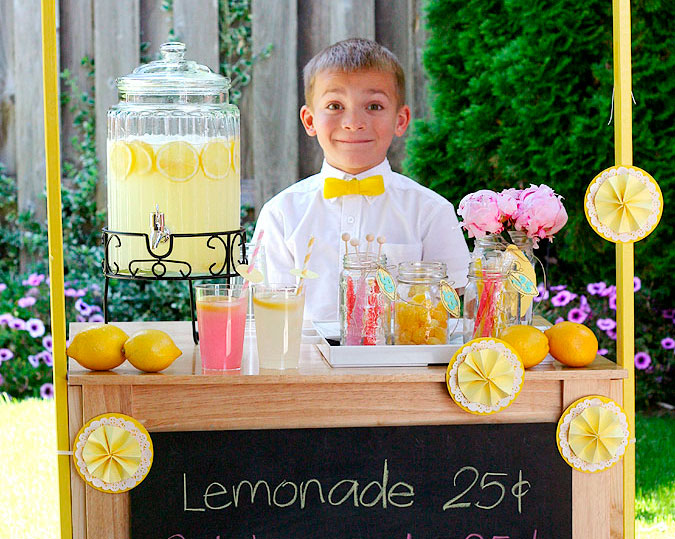
The-Lemonade-Stand1If we were running a company, a large portion of our budget would go to marketing, right? If we were selling shoes, our livelihood would depend on us getting out there and selling some shoes. Even if we were running a lemonade stand, we would understand that, in order to sell lemonade, we would need to make signs or hire neighborhood kids with megaphones to let people know that lemonade is available. If no one knows about our lemonade, then no one will buy it no matter how fantastic it might be.

But when it comes to our art, we’ve swallowed a toxic “starving artist” story, which tells us that we’re probably not going to make any money at this, anyway, so we don’t take the task of promotion seriously. In fact, most of us would probably do a better job promoting the lemonade than we would the art that we have poured our blood and souls into.

It’s crucial to realize that if you want to make a career out of your art, then you have gone into businesswith yourself. I am now the CEO of Nancy Stohlman, Inc., and my product is my work. If no one knows about my product, they can’t buy it. And then I am out of business.

But as long as we are stoking the starving artist story, then we’re going into the game already defeated. If we believe we cannot make a living out of our art…then we probably won’t.

2. The Overnight Success Story: “Once I’m famous someone else will do this.”

This is the story of the mythical artist who is catapulted into fame from obscurity with no promotional effort of their own. While this mythology is exciting, and the media loves to dangle it as some warped version of the American Dream, it’s also a bit like expecting to win the Powerball.

This overnight success story is a darling of artists and runs deep in our culture. But if you look carefully behind most successes, you will usually find a different story. Madonna made hundreds of demos with her own money and personally brought them to every DJ in New York City; Truman Capote sat for 8 hours a day in the lobby of the publisher who refused to see him. Even Rosa Parks, our favorite little old lady who wouldn’t give up her seat on the bus and thus triggered the Civil Rights Movement, was actually a veteran activist for 15 years when she was finally delivered to the right place at the right time.

Because that’s what it comes down to: “It’s not enough to be at the right place at the right time—you have to be the right person at the right place at the right time,” says musical agent Justin Sudds in his interview for “Take Your Talent to the Bank”. The truth of the overnight success story is that it is usually not overnight at all.

But what’s most problematic about the Overnight Success Story is that it is ultimately disempowering because it takes the responsibility for our careers out of our hands. Our careers become like playing roulette, and we feel powerless to affect real change. And I like playing roulette, but only with what I am prepared to lose.

3. “It’s Not Polite To Brag.” This country is still influenced by our Puritan roots, and so this story is the one that often paralyzes us into non-action.

Here’s the truth: Will some people be annoyed by your promotional efforts? Yes. But usually the ones who are annoyed, offended, or otherwise triggered by your efforts are the ones who have not yet embraced their own self-promotion. So it’s important to remember that their support or non-support for you and your work really has little to do with you and much more to do with where they are on their own path. It’s pretty hard to jump on someone else’s bandwagon when your own bandwagon is rusting in the garage. It’s pretty hard to muster up zest and enthusiasm for someone else when you haven’t put your own work out there in a big way, yet. So when you encounter this kind of resistance—and it can come from the most surprising places—be kind, and remember this quote: “Those who have abandoned their dreams will always discourage yours.”

But the rest of the people won’t care, and in fact they will be happy that you’ve made it so easy for them to support you and your work. It is said that a person needs to hear about something five times (yes, five!) before it sticks, and most people are happy for the reminders.

Self-promotion is not bragging. It’s asking for the support we need to make the careers we want.

In this Puritan society we are told that “it’s better to give than receive,” so we give, we give, we give…but most of us have a hard time receiving. And most of us have an even harder time asking for the support we need with clarity and confidence. If I want people to read my latest story—I have to ask. If I want people to come to my my website, my lecture, or buy my latest book—I have to ask. “Hey, I’d love it if you checked out my work and passed it along.”

In our everyone-for-himself society we have attached a stigma to asking for help. In order to get over this stigma, we have to remember that artists must exist in community, and in order to create and sustain a community, you have to put yourself out there with honesty and authenticity. Self-promotion is truly about asking for the support we need, and building relationships with those who are excited about us and our work. It’s the greatest thing you can do for the promotion of art outside of creating the art itself.

So when self-promotion starts to feel like self-prostitution, remember: We promote our work because we aren’t okay with the mythology of the starving artist; we respect our work enough to take control of its dissemination, not leaving it to the agent fairies to rescue us; we have both the confidence and humility required to put it out there in the world and ask for support.

Many of us don’t promote because we would rather fail privately than publicly  We fear rejection and ridicule; we retreat into craft instead. And yes, it’s true that Emily Dickinson did no promotion. But then again, she never got to enjoy the rewards, respect, and recognition of her work while she was alive.

I want more for myself and my art.

And I want more for you, too.