Ask A Flash Fiction Editor: Erasure

Ask a Flash Fiction Editor: Erasure

So first off, huge thanks to Denis Bell for allowing us to use his story in progress, “Dreams”, for our discussion of flash fiction today! (Full text of “Dreams” below).

One of the beautiful things about flash fiction is that, like poetry, it requires us to drastically trim, shrink, and carve our own thoughts. It leaves no room for bloating, filler, tangents or indulgences—and even forces us to utilize our silences.

Silences can be full of meaning—think back to the last time you sat in an uncomfortable silence with someone. What isn’t said is just as important—and often louder—than what is spoken.

ghost

The first time I ever heard the term “erasure” was in a class at Naropa taught by Laird Hunt. It was the first time that I had ever considered cutting intentional holes in my work, rather than just trimming to remove fat and fluff. Well-placed silences can carry huge implications.

Most of us understand the implication of silences in speaking. When I teach performance, I remind my students to

pause…

…because a pause is a way to emphasize what just happened.

Or

a pause can shift a mood… to prepare for what is coming.

As a listening audience, we understand the signals that silences create. We understand how the absence of sounds adds drama and importance to the remaining ones.

The same is true on the page. As a flash fiction writer, we can trim our stories to create gaps of information and to leave purposeful ghosts.

So Denis, let’s look at your story in progress, “Dreams”, with this in mind:

First off, I love the universality you establish as you begin to take us into the dream sequences—the images are both familiar and unique. I love the staircase he’d never noticed and I particularly like the way the family members come in and out. As the interactions with mother and sister grow even weirder, the story takes on a dimension of foreboding, the ghosts in the texts become real, and the reader is disorientated in a good way.

There are a lot of stories out there where a character “wakes up” at the end, (think Bobby Ewing in the shower of Dallas). But I like how you take that cliché and make it fresh by allowing the waking to be a vital portal into the final pieces of information (more on that later).

I think there are two (or three) important places in this story where some strategic cutting will activate the power of silences.

In flash particularly, you need to arrive into your story at the latest possible moment. And while your opening right now is fairly concise, I wonder whether you can begin with the second paragraph, jumping right into the staircase and the dream sequence? We will recognize the dream landscape in the title and your descriptions, so we probably don’t need that extra setup.

I have the same thought about the middle section where he wakes up and then falls back asleep. It seems to me that it serves as a literary device to remind the reader that we are dreaming, but again I wonder if a succession of dreams with no interruption would be more interesting? Without all the awakened asides, we will be fully embodied in the dreamscape, and we will accept the oddity of things (such as the mother talking to him even though she has been dead for 15 years) with the same certainty that Joe accepts them. (Brilliant, by the way, how you state that so matter-of-factly.)

Which brings us to the end. I really love the idea that the waking life Joe is contemplating suicide, and his dream world and dream sister stop him—it’s a great crossover. If you make the other cuts I’m suggesting, then the question becomes how do you successfully give us the suicidal info only at the end. I think the place to look is your last paragraph, where he wakes up with “steely intent” and thinks of the knife. The way it’s written now makes it almost seem as if he has never considered suicide until this moment. So we’re left wondering: what just happened? Is he so mad at his nightmare that now he’s going to kill himself?

We might need a longer beat between the dream world and the real world. Maybe when he awakens he’s reminded of his pain, which he had forgotten in the dream world. Perhaps we, like Joe, need to see a few choice items that remind us, “Oh yeah, we hate our life”. Perhaps he sees the knife sitting next to the bed where he left it before he passed out? The empty bottles? The phone off the hook?

Ultimately the ending will be most effective if we are gaining a final level of insight into Joe. This is not the “surprise! we were dreaming all along” ending that can come off as too easy but it instead adds a layer of organic surprise. Joe wakes up and remembers that he is in a hospital, missing both his legs. Joe wakes up and remembers that his wife left him. Joe wakes us and remembers…that he has nothing to live for. Whatever it might be. But do it through showing us what he wakes up into.

With a bit of focused trimming your story is going to ring both haunted and wise, lovely and liquid. You are almost there. Thanks for letting me play with it—keep going!

~Nancy

 (I welcome all comments and conversations, so join in! And feel free to find me on Facebook or contact me at nancystohlman@gmail.com)

 *

Dreams

By Denis Bell

On the day after his thirty-second birthday, Joe took a swing at the foreman and was fired. Now he spends most of his days in the bedroom, ensconced there with a bottle of Jim Beam and a bag of weed. He sleeps fitfully and has a series  of vivid and affecting dreams.

Joe’s apartment contains a staircase he’d never noticed before leading to a large suite of lavishly furnished rooms. The apartment is much grander than he had imagined. Children are playing in some of the rooms. A cousin packs up the mood in a plastic box to be buried in the back yard at the end of the day.

Joe is presenting a report in science class. A new teacher is standing at the back of the classroom wearing a hood that hides his face. Joe’s classmates are cheering but behind the hood the teacher is angry. The teacher reaches into his pants and pulls out a –

The clock on the bedside table reads a groan worthy 11:35. Beside the clock are a stack of porno mags and a wadded up rag.  The room is too bright.  He stumbles to the window. Outside there is snow on the ground. A child’s broken tricycle is rusting in a neighbor’s yard. He pulls down the blind and steps into the bathroom.

When he gets out his mother is standing there, pretending not to notice the magazines. Why did you leave us like that, she asks. Joe looks away.

She tells him about a house in the country she bought for herself and his sister. Sturdy wooden frame, brass fittings, hardwood floors. Nice gated community. She wants Joe to move in with them. Now that you’ve lost your job there’s no reason to stay in this dump. Soon, he tells her. The conversation seems strange because both mother and sister have been dead fifteen years, but it would be rude to point this out.

Fragments of Joe’s past float through his dreams. The ramshackle house where he grew up. The dank cellar with the rusty furnace. His sister with her coloring books. Days spent fishing alone in the creek. His father fish-eyed and silent.  His mother grimacing as she reaches to button his coat, his father absently nursing a damaged hand.

The swish of a belt.

His mother’s cries.

Bloodless lips, twisted in silence.

White napkins dark and crusty with dried blood.

Memories from the night they died.

Don’t hide in the cellar, lend us a hand, his sister says (bossy as ever).

Joe awakes with a start, head full of steely intent. Thoughts of kitchen utensils. He starts to climb out of bed but a hand restrains him. Not yet, a voice whispers.

Flashnano Pep Talk/Writing Flash Fiction: What You Don’t Say Is The Story

In the month of November, in solidarity with our Nanowrimo friends, we’ll attempt to write 30 flash fiction stories in 30 days.

So you’re going to try your hand at this flash fiction thing, huh?

In the beginning you will still very often land closer to the 1,000-word cut-off mark, trimming and pruning to make sure your story makes it into the official flash fiction guidelines. As you become more comfortable with the form you will find that your stories naturally shrink and start to land well beneath the 1,000-word mark.

What happens in between is a process of letting go.

Boy-Jumping-From-a-Plane-with-an-Umbrella-76482First of all, let go of being good at it. Whether you come from poetry, longer fiction or nonfiction, it takes a while to get used to the new form. So let go of the need to be an instant expert. So many of us find it frustrating to “start over” and embrace being a beginner in a new genre. I invite you to instead see it as an opportunity.

Let go of exposition. We have become fond of our exposition techniques, our lush, sardonic, witty, poignant, clever, or otherwise expository voices. This is often the first thing to let go of in flash. It doesn’t mean you must let go of it altogether, but your urgent storytelling voice must trump your love of exposition for the magic to happen.

Let go of description. Not all together, but let your description come only in service of your storytelling. Let go of the urge to linger. In flash fiction, one well-placed detail brings an entire story into focus. Opt for one or two telling details over a wash of description—you just don’t have that kind of time.

Let your silences become informative. Don’t rush to fill them. As we learn to let go of exposition and description, we learn to embrace silence as a tool, and the juxtaposition of silences to infer information.

Let go of extra words. Try removing words and see if you can create potent gaps of intuition. See how much you can not say. Often what you don’t say is the story.

So what’s left you ask?

What’s left is tightly crafted little nugget of concentrated gold.

What’s left is flash fiction.

~Nancy Stohlman

Check here for daily Flashnano Prompts during November.

Join our Facebook Event page here.

“The Hostess”

Flash fiction by Nancy Stohlman

The hostess decided to throw a small dinner party, just the neighbors and a few friends, just something to lift her spirits. She made pot roasts and French Onion soup from scratch while he retreated to the basement.

There was a few weeks truce, an uneasy truce for the sake of the children, and then another all-night battle followed by a series of murder mystery parties, complete with costumes, wine tastings, realistic weapons rented by the hour, and yucca whipped into small hills as light and fluffy as French pastries.

By the end-of-summer-Hawaiian-luau, the hostess was holding back tears through her fake eyelashes and long, black wig as he moved his things into the spare bedroom: You invited them, you entertain them! he yelled, slamming the door. The guests tried to keep her glass filled with an assortment of specialty rums and freshly crushed papaya mixers.

Soon the invitations started going unanswered; the guests found excuses for not attending the 1950’s sock hop, the M*A*S*H party, the “1001 Arabian Nights” celebration complete with whole roasted goat. Come spring, the 25-foot-tall Maypole looked desolate, pastel ribbons hanging limply like unwashed hair.

But today, the sound of hammers. It would be the greatest party she had ever thrown. Everyone would come. A crew of a dozen was sawing, hammering, painting, and creating a to-scale facsimile of the Titanic. Another crew was bringing in 500-gallon tanks of water that would, at the appropriate moment, be released into the back yard, while the guests, in full pre-World War I formalwear (as specified in their invitation) would get into actual lifeboats and attempt to row themselves to the safety of the house. A caterer was reconstructing an iceberg two stories high, and, at 11:40 pm, the gong she rented would sound, the string orchestra would begin to play, the water would begin to rise and the guests would file into lifeboats, of which there would, of course, be too few.

Originally published by Pure Slush. Read original here.

Nancy StohlmanNancy answers The Hue Questionnaire:

What is your favourite colour? Why?

Red. When I was 10 I was told by the Avon Lady that I was a “winter”

Do you wear this colour? How often and when?

As often as I possibly can. Lipstick. Boots. Red sparkles if I can get away with it.

What does the colour suggest to you?

Wonder Woman at a voodoo German sparkle party.

What does it not suggest to you?

Barfing out the window of a moving RV.

How long has it been your favourite colour?

I’m pretty sure my placenta was red.

When does it work best?

Here’s the thing: Red is both celebrity and paparazzi. When a person walks into a room embodying red, everyone secretly feels better: Red has arrived. It’s kind of like when someone brings the Hot Damn Cinnamon Schnapps to a wedding reception. Maybe you wouldn’t have done it yourself, but you’re glad to know that someone else has, and you might crowd around that person and even take a swig because it will make your story better later.

When does it not work for you?

When I want to disappear. There are plenty of days I just can’t live up to the expectations of red.

How does the colour relate to you, or you relate to it? Are you this colour or is this colour you?

At my best, I am always red.

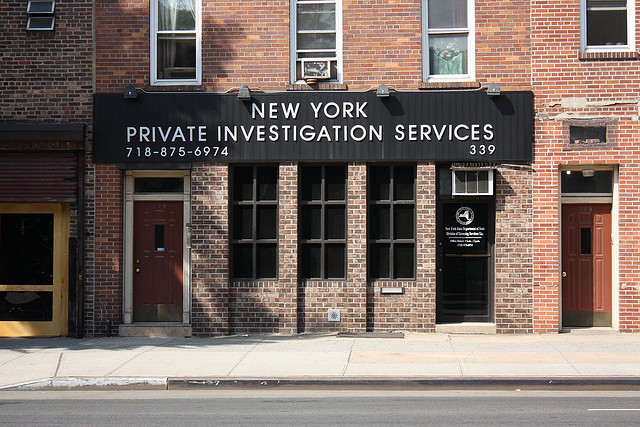
“The Private Investigator”

Flash fiction by Nancy Stohlman

I walked into his office and closed the door. There were piles of papers everywhere and a deer head hanging on the wall.

What can I do for you? he asked.

Well, I just don’t know what I’m doing half the time anymore, I said. I think it would be great if you could keep an eye on me.

Sure, he said. Is someone threatening you?3.21-PI

No, nothing like that. It’s just me. I can’t trust myself.

Any clues or suspicions?

No … but the whole thing is pretty suspicious.

He pats my hand. You’ve done the right thing, he says. Usually if you suspect something to be true, it is.

I left his office feeling much better. Almost immediately the eyes were upon me—cars that followed a bit too close and too long, people watching me from across the street. At home a red light blinked between the books on my bookshelf.

A week later I returned to his office. Well, we have news to report, he says. Are you ready?

Yes, I nodded, sitting down.

The first picture was my car parked in front of the post office. If you’ll notice, he says, circling areas of the photo, this is a no parking zone and the sign is clearly displayed. The subject arrived at 3:14 and parked for 23 minutes, in blatant violation.

I nodded, didn’t say anything as he handed me the photo.

During the car ride home, subject picked her nose and then, after looking around, consumed it. At 5:17 subject arrived home, drew all the blinds, and proceeded to watch XXX rated videos for 17 minutes, the final one, 80-year-old grandpa does his nurse, commencing in what we presume was an orgasm.

Subject, after watching said video, stared at the computer for one hour and forty-six minutes without pants on. The phone rang on three different occasions and the subject ignored the calls without even checking the caller ID.

Subject smoked marijuana at 9:16 and then took a bath while drinking an airplane-sized bottle of cinnamon flavored whiskey. During the bath, subject appeared to have a conversation with no one that lasted for 11 minutes.

At 11:34, subject got into bed and read a book until 12:13, when she turned off the lamp to presumably sleep. Then the most curious of all: at 12:21, just 8 minutes later, the subject got out of bed and laid directly in the middle of a moonbeam shining through the skylight. Subject cried until 12:31.

After that, our man couldn’t see anything else. He handed the stack of pictures to me.

I sighed. I’m not completely surprised.

If it makes you feel any better, I see this kind of thing all the time.

I guess it’s just better to know for sure.

I’m sorry to be the one to have to tell you, he added, handing me a tissue.

 Originally published in Atticus Review. Read original here.