Going Short turns 1 year old!

It’s been one year already! I’ll be celebrating and looking back all week and sharing some of my favorite “SHORT” memories along the way. Thank you to Ad Hoc Fiction and everyone who has been on the journey with me! Remember this book trailer??? (Below)

“A fun and eminently useful literary treasure map.”

~Kirkus Reviews  starred review

Winner of the 2021 Reader Views Award!

readers view award sticker

Finalist for the Next Generation Indie Book Awards

Finalist for the International Book Awards

Order from Ad Hoc Fiction

Order Amazon/Kindle on Amazon UK  or Amazon USA 

U.K. folks: You can now order from Waterstones!

Or buy a signed copy from me here

“In Going Short, Nancy Stohlman captures the true spirit of flash fiction, those brief narratives imbued with all the urgency of life itself. An extremely practiced flash fiction writer, Stohlman is also a veteran teacher. She knows the territory and takes us on a trip from getting started to the finishing line, and everything in between. It’s hard to think of a more thoughtful, adept, and enthusiastic guide.” ~David Galef, author of Brevity: A Flash Fiction Handbook

“Nancy Stohlman has written the definitive, and appropriately concise, book on the flash fiction form. You’ll learn what flash fiction is and isn’t, tips on writing it, tips on honing, sculpting, and polishing it, along with thoughtful discussions on the flash novel and tips for pulling together a flash collection. As a widely-published master of the form herself, Stohlman brings years of teaching experience and her own engaging voice and wit to this useful, encouraging, and entertaining guide. A must-have for flash writers of all levels.” ~Kathy Fish, author of Wild Life: Collected Works 2003-2018

“Going Short embraces the urgency and compression of flash in presenting specific, fresh suggestions for creating, drafting, revising, editing, and publishing both individual pieces and full collections. It’s a book that knows and teaches by doing. It is inspiring and insightful, a masterful craft book written by a master of the craft.” ~Randall Brown, author of This Is How He Learned to Love

“This book is an invitation to flash dance with Nancy Stohlman, an accomplished partner who will show you the steps you can take, the fluid moves you can make on the flash fiction studio floor.  It is all about practice. She will spin you around and show you things you didn’t know you could do, and lead you to a kind of prose performance you didn’t think possible.” ~James Thomas, co-editor of the Norton Flash Fiction books
Order Going Short Now!

Writing By Hand: Too Much Work? Let me convince you…

Friends!

Thanks for joining me on virtual retreat last month as I scouted Spain (more on that soon!) and gathered with a small group of writers in southern France for an inspiring week of rest, rejuvenation, and radical creativity. And if you were following along, some very interesting discussions happened along the way, including foreign languages, beauty in decay, topless beaches (!) and one that I want to talk more about here: writing by hand. 

I’m not talking about writing by hand only to capture your inner chatter or to clear your mind or to know yourself. All things I highly recommend and consider a necessary part of a creative life. I’m talking about actual creative drafting. The actual idea. The first draft. By hand. 

I would not be exaggerating if I said 99% of my first drafts happen on paper. For me, the computer is for sculpting and editing, but the genesis of the idea is a delicate spark that happens in the quiet of the page, the intimacy of pen tip to paper. Like a first kiss that happens over and over and over each time the notebook opens.

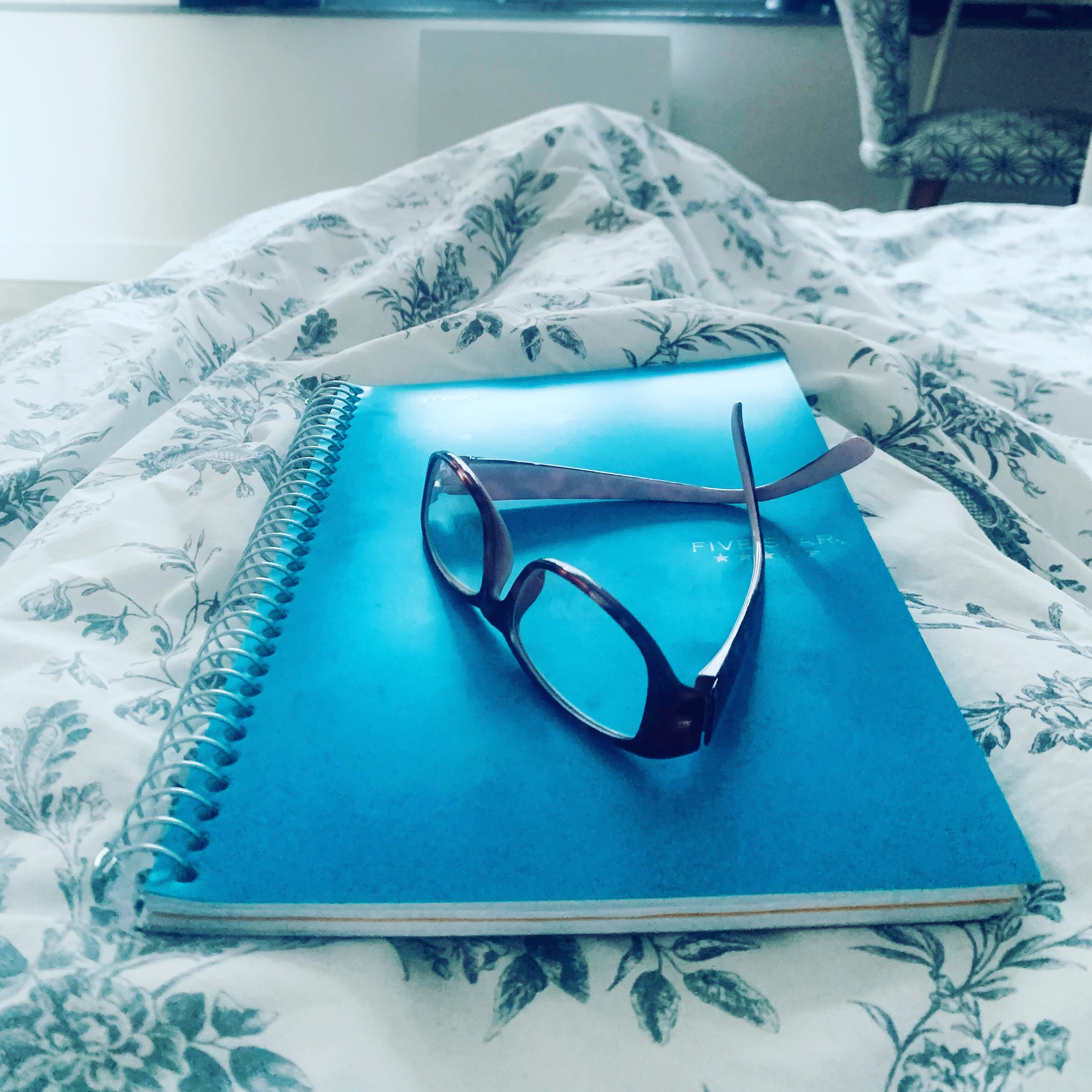
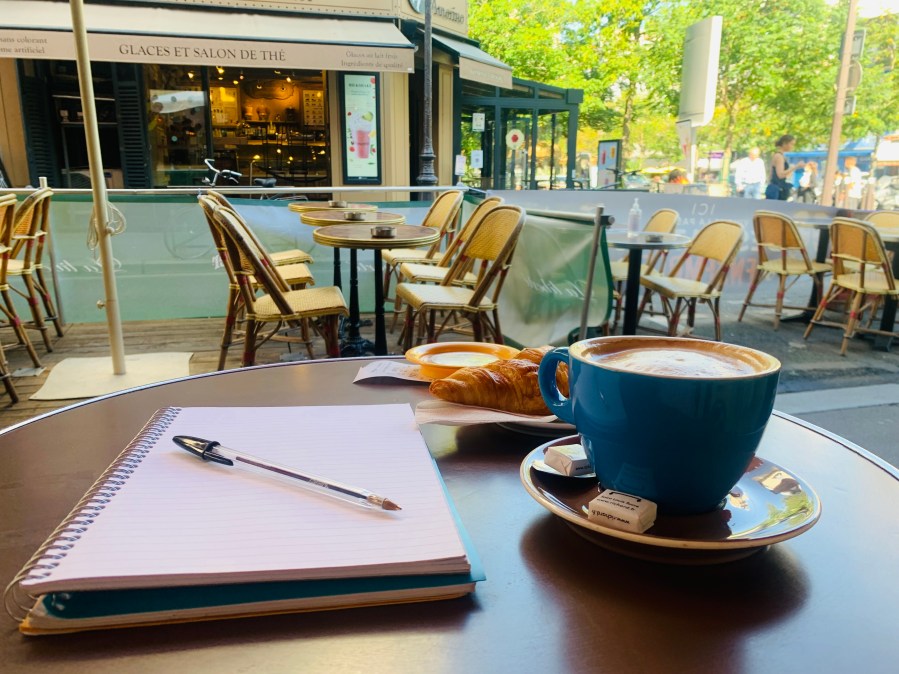
(some of my notebook’s recent adventures)

In Going Short I talk about re-writing drafts from scratch when I’m searching for the right words or rhythm and I just can’t seem to “edit” myself there. But what I failed to mention is that I also do this by hand. Switching to the notebook, especially when stuck, can jar you back into the creative flow for many reasons including: 

Location independence. You can write anywhere—at the restaurant, under the backyard tree. On the park bench. At the DMV.  On the train. Even in bed—honestly many of my ideas come first thing in the morning while I’m in bed. Before my eyes have fully sharpened out of sleep, as coffee is just waking up my system, I find it easier to harness the dream world on a raft of paper and pen.

By hand. Handmade. We slow down when we write by hand. In the stillness we feel the pen and ink, the crinkle of pages, the loops of our own words unspooling across the white. It is a tactile experience that shifts the way our brain connects to syntax and activates a more intuitive part of the brain. I find that different sorts of ideas arrive in the notebook than to the screen, or at least a different version of those ideas, often already in conversation with each other. (I worked with a wonderful writer recently who “found” her character’s distinct voice when she moved to the written page.)

Evading the critic. When I write by hand my critic is less….critical. Since the work is not typed up and in TIMES NEW ROMAN, it feels more like play. And that’s the trick: if you can fool yourself into believing what you are writing (by hand) doesn’t count, then you relax. You start to have fun. You follow tangents. You get silly/messy/weird/beautiful….brilliant. You take creative risks that feel too intimidating on the official screen, in the official font. And in taking those risks…you often find your truth. You go deeper.

(As an interesting aside, when I’m journaling my handwriting is neat and lovely and legible. But when The Muse descends and I’m actually drafting the idea on the page my handwriting becomes wild, a gallop, a sprint—looping and furious, barely legible even to me. It’s almost as if two different hands, two different minds are at work.)

An organic second draft. Another wonderful thing happens when you write by hand: you eventually have to type the (good) stuff up. Therefore, what came out unhindered and unrestricted gets an organic first edit just in the typing-up process. (This is different than editing WHILE writing–which I never recommend. You are now sculpting. Second draft. Different process. Different hat.)

SO…

If you or your writing is feeling stuck, or you’re needing an inspiration boost, or the blue light of the screen or the ergonomic familiarity of your office chair feels lackluster—try walking away. Grab a notebook and go to bed. Or to the living room. Or to the porch swing. And yes, to the café or in the park. 

Take the question, or problem, or idea to the page like a devotion. Lay it on the altar of paper and pen and allow the answers to come through your hand.

Love,

Nancy

P.S. And if that wasn’t enough,SUMMER 2022 FLASH FICTION RETREATS will be opening soon with TWO exciting destinations (any guesses where?)
Sign up here for Notifications and First Access:

July 20: Denver Fbomb with Host Nancy Stohlman and Featuring Rob Geisen in “Things That Are 50”

Our July Fbomb is a Throwback to the Very First Fbomb ever in 2013 with original host Nancy Stohlman and original featured reader Rob Geisen!

As always, expect readings from host/feature/open mic guests that are hilarious, irreverent, profound, thought-provoking, satirical, and just about everything else.

You have never been to a reading quite like Fbomb! Discretion advised (don’t bring your grandma!)

Join us on July 20 at 7:30 pm MDT on Zoom!

YOUR PROMPT

Travel back in time to the year 1971: a year that first saw the birth of Walt Disney World, the Apollo 14 Mission, the First Email, and the first McDonald’s Quarter Pounder.

What else is 50? Mark Wahlberg aka Marky Mark (raise your hand if you remember Marky Mark and the Funky Bunch). Mary J. Blige! Shannen Doherty! Ewan McGregor! Malibu Barbie!

So is Willy Wonka and the Chocolate Factory and A Clockwork Orange: 2 of the best book to film adaptations!

Both Dirty Harry and Shaft were born in 1971!

Did you know: $50 in 1971 is equivalent to about $332.34 today?

OR take another approach to the 50 number prompt: Maybe a 50 word story, a 50 sentence story, or a list of 50 Things…

There will be a limited number of open mic spots–sign up at the event!

Have fun and happy writing!

Zoom link

Nancy Stohlman’s latest book, Going Short: An Invitation to Flash Fiction, was a 2021 Reader Views Gold Award winner, a Next Generation Indie Book Award finalist, and an International Book Awards finalist. Her fiction has been anthologized widely, appearing in the W.W. Norton anthology New Micro: Exceptionally Short Fiction, Macmillan’s The Practice of Fiction, and The Best Small Fictions 2019, as well adapted for both the stage and screen. She teaches at the University of Colorado Boulder and around the world. Find out more at www.nancystohlman.com

Rob Geisen. Author of Beautiful Graveyards, Paper Thin, Avenge Me, The Aftermatch etc, I See You Lewis. Guitarist, Casio Keyboardist and broken romantic for the band Girls Just Wanna Have Us. Currently focused on writing sci-fi novels and learning everything there is to learn about The Outer LImits, the history of paperback science fiction, Theodore Sturgeon, and the works of Jake E. Lee. He used to host open mics with Olatundji Akposani. He used to be Get in the car, Helen. He used to not almost be 50 years old.

Beauty in the Aftermath: A Creative Call to Action

Friends,

Are you feeling the shift? Something in the water these last few weeks… unfamiliar frequencies, extra static that you can’t quite put your finger on? A cautious shift into…joy? Hesitancy? Both?

In the U.S., there has been an impulse to move forward, and quickly! Take off your masks, everyone! Hug your friends! Go to Disneyworld! And yet it’s unsettling. For 18 months we’ve been dreaming of this kind of permission, but now we may feel stunned. Pausing in a fog of new feelings.

I’ve been trying to put a name to this feeling for weeks. It’s like slipping between worlds, inhabiting a strange, transitional, duty-free zone between here and there. A kind of reverse culture shock tinged with trauma.

Go with me for a minute…

You probably know about culture shock—if you’ve experienced it, you may remember feeling unmoored in the new spaces—not quite sure how to navigate in the face of so much difference. But…you eventually embraced the unfamiliar and opened your heart to the difference, and in that opening you found new ways, new foods, and new rituals.

I mean, that’s why we travel, right?

Fewer people talk about reverse culture shock. I first experienced it after spending 3 weeks on an anthropology trip in Nepal in college. We had been well prepared for the culture shock of Nepal—but, after 3 weeks of adjusting to a new everything: new climate, altitude, food, customs, time zone— we were completely unprepared for the re-entry. We had changed, and the old ways now seemed foreign and awkward. 

Returning created just as much disturbance as leaving—maybe more because we were unprepared for it.

But reverse culture shock is only part of the current equation. There is also the very real trauma of surviving a life-threatening situation. I don’t use the term PTSD lightly. But we carry the aftermath of life-threatening trauma—wars, accidents, abuse, starvation, or a deadly pandemic—in our bodies, sometimes for years, maybe even a lifetime. My grandparents lived in the shadow of the Depression for the rest of their lives.  

It was once explained to me that US soldiers in Vietnam began to experience more frequent instances of PTSD in part because of airplanes. In earlier wars, soldiers traveled home by ship, a process that took several weeks, and they traveled together. There was a natural buffer—a liminal time between the site of the trauma and the re-emerging into society. There were weeks of distance, processing, grieving, and connection among the soldiers that helped the re-entry process. But in Vietnam (and subsequent wars), most soldiers were debriefed and flown home on airplanes—leaving them only 18 hours to transition worlds. Which means they were in a war zone on Tuesday; thrown into their old lives and their old relationships on Wednesday. No wonder they struggled (and continue to struggle).
 
So combine the two—reverse culture shock with a bit of collective PTSD, and we get closer to defining this strange, in-between space we’re inhabiting these days. We are facing the aftermath and not sure how to reacclimate.

So now what?

What does a community of sensitive, emotionally attuned people do now, at this threshold? When there is a feeling of cosmic trepidation, hesitation, when making simple decisions seems overwhelming? When your creative work—wherever on the continuum you’ve been over the last 18 months—is again shifting. Perhaps the ripples we’ve been feeling is humanity herself shaking to be alive.

Now, as always, we turn to the artists—you and me—to hold a new vision of the world. More than ever we need the beauty makers and visionaries, the poets and painters and preachers. The storytellers. Our time has come, fellow art makers. Now, in the Reconstruction of our world—let’s help to leave it better and more beautiful than we found it.

Proud to be on your team,
Nancy
xoxo