Australian writer Matt Potter’s creative and publishing endeavors are many–he’s written and published fiction, non-fiction, textbooks, curated anthologies, and always seems to be pushing himself into new territory, always willing to try something new and ask “what’s next?” In his latest solo writing project, On the Bitch, Potter again shows that he’s a man of many skills, weaving his signature snark, wit, and always clever insights across the scope of a novella. With sitcom-like humor disguising something much more profound, Potter is truly a writer “without the wank”.
Nancy Stohlman: Describe this book in 6 words
Matt Potter: Five adults talk, eat, argue, implode.
NS: This is not your first book. You have also published Hamburgers and Berliners and Other Courses in Between, Based on True Stories, Vestal Aversion, among others. How is this book different than your other books?
MP: Well, it’s a novella (apologies for being so obvious!) and the main plot is told in a very linear way, so there is a strong through line through the whole book.
Hamburgers and Berliners is travel memoir and Based on True Stories is a collection of short stories (some flash).
Vestal Aversion is a collection of short stories, flash, and short non-fiction.
I have also published two volumes of resources for English as a Second Language (ESL) teachers: all you need is … a whiteboard, a marker and this book! Books 1 and 2 … so all these books are different.
My interests are many and varied and this is reflected in the structures and subjects and genres of all the books. I know I have answered this looking at the question in a very concrete way but I do think they’re all, even the ESL resource books, much the same in tone and feel. There is a lot of fun and humour and absurdity in all the books.
Actually, all the books can be taken apart and chapters or sections exist on their own. Writing this I realise that again, cutting and shaping and picking up and putting elsewhere and creating a new whole from disparate parts is endemic to everything I do.
This is a much deeper question than I realised when I initially read it, Nancy! I think that is a skill of yours …
NS: Can you talk about the title? I was waiting to see the phrase come up in the book and it didn’t so now I have to know: Is this Australian slang? How did you decide to go with such an in-your-face title? (P.S. I’m pretty sure all the people on the train raised their eyebrows as I was reading!)
MP: Many Australians (of certain generations) instantly get the title BUT it’s not slang.
On the Bitch is a reference to Neville Shute’s post-apocalyptic novel On the Beach (published in 1957, original film released in 1959) which takes place in Australia.
The non-inclusion of the word ‘bitch’ in the book was deliberate: I had one in the book but it was so obvious I took it out. (There are plenty worse expressions used in the book anyway!)
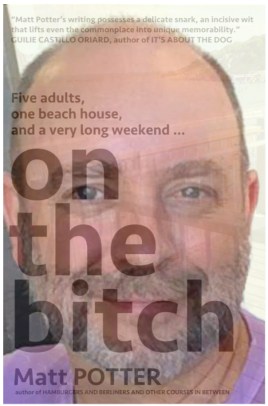
And most of the novella is set on or near the beach at Port Elliot, a town I visit regularly and stay in once or twice a year. I had the front cover image for years – it’s a photo I took of the beach at Port Elliot – but the design was not working: the photo’s colours are muted but placing the title over the image was proving difficult. So I added a scrim over the image and experimented with the title’s font size. The excessively large font seemed to work best.
I do enjoy cover design. But that cover design took me a long time to bring together.
It never occurred to me the cover might make readers in public spaces uncomfortable (A.E. Weisgerber pointed that out to me) but the upside is, it is noticeable and sparks interest. (A.E. Weisgerber pointed that out to me, too.)
But bitch / beach also refers to Magda’s continual mangling of English, plus all the characters are not the nicest of people … ‘bitch’ could be referring to at least 4 of the 5 main characters.
But you could imagine Magda saying, “Hugh, I am just for twenty minutes going walking on the bitch. I will be taking my zapper to be zapping things.” (I had lots of fun writing Magda’s dialogue.) And you would be unsure if Magda deliberately made that mistake too.
NS: I hadn’t realized until the end that this book was started from prompts you solicited from other writers. Talk about that process. Did all the pieces included come from prompts or did it take on a life of its own at some point?
MP: I originally set myself the parameter of 500 words per chapter or story, each based on one of the prompts I was sent by other writers (and that I had asked for, to kickstart my own writing again). But those parameters started to prove limiting, especially as I realised the smaller stories could form one longer complete story. And the whole point of asking for the prompts (in 2012) was to get me back into writing.
So I abandoned the idea of 500 word limits and only using the prompts, and let the story develop. So some chapters are longer than 500 words; and some were inspired by the prompts, and some not.
It was more important to have a completed book I felt worked as a book, rather than a book that stuck to rules I had set myself, yet remained unfinished, or finished but incomplete because of some fancy, silly guideline.
NS: Do you often work from prompts? What do you see at the benefits/drawbacks of prompts?
MP: I don’t often work from prompts but I set them all the time for publishing projects.
Prompts are great! I especially love working around prompts. I have no time for writers who say, But prompts are so limiting. I don’t agree: they can be amazingly liberating. If you are a writer worth any amount of salt, a prompt can be incorporated into any story at all. Yes, any!
The best prompts are simple, often one word, that can be used very generally or very specifically. Here are some from this very paragraph that should get many writers’ juices flowing: limits, liberation, salt, incorporation, best, one, juice, flow.
But remember, a prompt is a prompt: it’s not the whole story.
NS: In one scene your character refers to getting sucked into “conversational quicksand”. In a way, I think the whole book is about getting sucked into various types of relational quicksand. What do you think your book is saying about relationships?
MP: Have you ever looked at a couple (straight or gay or any part of the expanding rainbow), completely unknown to you, and thought, What on earth do you have in common? What could you possibly see in each other? That used to happen to me all the time, observing couples and thinking, I don’t get what holds you together!
I still think that sometimes, but having just celebrated my 28th anniversary with my partner (and NO ONE is more surprised than me to have been in a relationship for 28 years! How did that actually happen?!) I realise that so often what holds people together is a mystery. It’s something only those in the relationship understand (maybe), and presumably, the benefits outweigh the costs. (Laughter is a biggie for me. Does he get the joke?)
What fascinates me about relationships (intimate relationships, family relationships, friendships) is this: what deals do you do with yourself to stay in those relationships? How do you manage it? What compromises have you made? What do you get out of it? What do you put into it?
I am not that great at compromising in a work situation – I’ve had a lot of problems at day jobs for not toeing the line, for being unable to mould myself into the person management wanted, or thought they wanted – which is much the same issue.
How have you compromised to lead the life you lead?
Beyond food, water, shelter and a sense of self-worth, what else is there in life that’s really important other than relationships?
I also worked a social worker for 20 years, and a lot of that work was about relationships and relationship issues.
Ultimately, On the Bitch is about the deals we do (with ourselves and others), and what we will put up with to lead the life we do, or want. What cost do we pay?
NS: There is a theme of “rich vs regular people”. Can you talk about how this theme and how it manifests in your work?
MP: While this may sound incredibly naïve or stupid, I don’t believe people should be rich.
It enrages me that Notre Dame Cathedral can burn down and a billionaire steps forward with all the money to restore it! To have that amount of money at your disposal is manifestly unjust. (I have no qualms with the cathedral being restored, however.)
If I were a billionaire (I know, dream on, dream on) I would give most of it away. I love that idea of giving …
It’s also about money not being able to buy you taste or sense or talent.
Money, serious money, can be a great blinder. That is what happened to Otto in On the Bitch: he has become blind to his own wealthy crassness. Or rather, his money has given him the self-belief that he can be as crass as he likes, because (in his world) money talks.
The only one who really appears to have it together is Kendalynn, who for a long time comes across as the silliest of the five main characters. She married Otto twice and then had lots of plastic surgery (another sign of having too much money). She even used her inheritance to get a facelift!
I admit to being prejudiced against people with lots of money.
(And I can’t take people who’ve had plastic surgery seriously either, unless it was life-saving or corrective. You should give the money for your next facelift to the poor.)
Yet nor does my writing preach that being poor is salt-of-the-earth wonderful … that’s a falsehood, and is used as a sop to keep poor people poor. Ah, we might not have money, but we have each other …
I don’t believe that money can buy you happiness but I do believe it can buy you ease.
I will never read a Harry Potter book but love and admire the idea of J. K. Rowling giving her money away for good causes.
Ultimately, my issue is with privilege, and the perception that money buys you privilege. But I also recognise that as a white, middle class, university-educated professional male living in mainstream Australia, I am enormously privileged.
NS: Being an ex-pat is another theme that comes up a lot in your work. In this book the ex-pat has come home, so to speak. Can you talk about being an ex-pat yourself and how that influences your writing?
MP: I lived in the UK for a year in 1983, the year I turned 17, and my family and I were continually confronted with the old culture vs. new culture dilemma: we just do it this way because we’ve done it this way for hundreds of years. It’s just the way we always do things here! (It’s another side to “If your best friend jumped off a cliff, would you do it too?”)
PLUS, we went from living in a city of a million people (Adelaide) to a town of 6000 people (East Yorkshire), which was perhaps a bigger shock.
(Living overseas also made me feel more at home in my own culture … but that may also be simply about growing older, and maturing.)
And then I lived in Germany for much of 2008 to 2010. As a man in his 40s, a native English-speaker with many tertiary qualifications and much experience, I was the next best thing to being a native German. BUT it was still damned hard to navigate, not being from that culture.
But, you can take the best from both worlds if you can work it that way …
Coming back to Australia is always difficult when you’ve been overseas, though that’s not unique to being Australian. Every culture has its pluses and minuses and again, it’s the deals you do with yourself that make a situation tenable or untenable. How much will I put up with before it becomes too much and I have to return home … or leave home again?
Perhaps my writing is often about trying to make sense of your world, and your place in it … which is universal for all people. Isn’t it universal for writers, too?
As an ESL teacher (as I have been), living overseas and learning another language is invaluable. You can view the world (and your world) a little differently.
CODA: Hamburgers and Berliners was published in 2015 (though written 2008 – 2009) and On the Bitch was published in 2018 (though written mostly in 2012) so while the ex-pat was alive and well in my writing when I wrote those books, the ex-pat is probably much less likely to feature in my writing now … if I was writing anything.
NS: You have a scene where the characters are going to Sunday lunch served by nuns, and this is referred to as something “Australian”—is this a real tradition?
MP: I had to look that up in the book to answer the question! … so, no, nuns are not part of the traditional Sunday lunch, that was a joke, but the roast lunch on Sunday is very much a tradition for many Australians (Anglo, mainly).
Well, for some Australians it’s a tradition and for some it’s a myth, but it’s more about gathering together with family on a Sunday, for lunch. I’m from the mainstream culture in Australia so I understand the Sunday roast is very much a mainstream tradition.
As to being served the lunch by nuns, no … now I have images in my head of Australians across the country being served a Sunday roast at home by an army of nuns! As far as I know, I’ve never had nuns serve me lunch … though I did eat a crêpe made by nuns at an amusement park in Mulhouse in France in 1983!
NS: You write both fiction and nonfiction—can you talk about truth in writing? How does fiction/nonfiction serve to tell truth and or vice-versa? Do you have a preference?
MP: I prefer writing fiction because ideas just pop up in my head, often titles or expressions or a bizarre situation that begs explanation. Though writing about my life is basically dull for me (yes, even though I wrote a travel memoir!) I much prefer reading non-fiction for my own personal reading. So I have a dichotomous relationship with fiction and non-fiction. I love just making things up but also believe that truth really is stranger than fiction.
But I acknowledge that in some ways you can tell the truth better in fiction because writers can veil themselves behind many layers (and hopefully, avoid causing offence).
In non-fiction you are bound by the truth … but I believe it has to be 100% true, otherwise it becomes ‘based on …’. Now, the interpretation of what is true – your truth or my truth? – can differ, obviously.
Though all fiction comes from some grain of truth, somewhere.
(An aside: my collection Based on True Stories is 99.9% fiction!)
NS: This book was published by Truth Serum Press, which is an imprint (I believe) of other presses that you manage—a spiderweb of publishing from down under. Has Truth Serum replaced the other imprints or does it exist alongside? Explain.
MP: In its simplest form:
Pure Slush began publishing online in 2010.
Pure Slush began publishing in print in 2011.
Pure Slush online and Pure Slush in print were run quite separately, with about .0000001% crossover, even though I managed both.
Truth Serum Press was established as an imprint in 2014. I specifically wanted an imprint where there was no expectation of online companion-publishing.
Everytime Press was established as a non-fiction imprint in 2016.
Pure Slush ceased online publishing in 2017. (Basically, I was bored with publishing online: neither my heart nor head were in it anymore.)
The differences, as they exist now are:
Pure Slush Books only publishes (multi-author) anthologies.
Truth Serum Press publishes single author books, and just a few (multi-author) one-off anthologies.
Everytime Press publishes travel, memoir, resource, and other non-fiction books.
This diversity means I get to publish a lot of different things, which makes it much more interesting for me … my 77th book as a publisher is just around the corner …
Over the next few months:
Truth Serum Press will release short story collections from Australian writers Steve Evans and Lewis Woolston, and Canadian writer Salvatore Difalco; and a poetry collection from US poet Alan Walowitz.
Everytime Press will release an armchair philosophy book by Australian writer Paul Ransom.
Pure Slush Books will release the anthology Pride 7 Deadly Sins Vol. 7.
Truth Serum Press is currently calling for prose submissions (fiction and non-fiction) for Stories My Gay Uncle Told Me: https://truthserumpress.net/submissions/anthology-submission-guidelines/stories-my-gay-uncle-told-me/
NS: What advice would you have for other writers wanting to write a book?
MP: You have to sit down and actually write. You don’t need a computer, you can use pen or pencil and paper. It might seem old-fashioned but it’s often not as daunting as a blank computer screen, and it still works.
Write what you know.
Write what you want to know.
Write about what you don’t know, but then be prepared to research or imagine.
If the work you are writing is boring for you, odds on it will be boring for readers.
There are lots of rules and some are good and some are not. Work out which rules work for you and which do not … but also be prepared to change.
Writing is organic … sometimes you just have to go on the journey. You can always come back later to a fork in that journey.
Being organised is better than not being organised.
No publisher or editor likes a disorganised writer. (And no writer likes a disorganised publisher or editor.)
Discipline is great BUT you also need to live and experience. You really do need to go out and smell the roses (and the dogshit) and not just write about them.
Most writers, when they talk about their writing, are boring. Talking around their writing is usually much more interesting for all concerned.
Verbs are a writer’s best friend: get the verbs right and 90% of your work is done!
NS: Anything else you want to add? Links or other promo?
MP: Find On the Bitch in all formats here: https://truthserumpress.net/catalogue/fiction/on-the-bitch/
Find Truth Serum Press here: https://truthserumpress.net/
Find Pure Slush Books here: https://pureslush.com/
Find Everytime Press here: https://everytimepress.com/
On the Bitch by Matt Potter
Truth Serum Press, 2018, 170 pages
Paperback ISBN: 978-1-925536-45-4
eBook ISBN: 978-1-925536-46-1
Matt Potter is the author of a travel memoir, Hamburgers and Berliners and other courses in between; two collections of short fiction and non-fiction, Vestal Aversion and Based on True Stories; the ESL teaching resources all you need is … a whiteboard, a marker and this book! Books 1 and 2; and the novella On the Bitch. A former teacher and social worker, he lives in Adelaide, South Australia where he now works in childcare, and as a publisher and editor.



 Nancy Stohlman