Write your book in Mexico or India?

Dear Friend, 
Making art while the world is on fire is a true act of resistance. 
And this is no ordinary writing retreat.

Ask yourself these important questions:
·        How are you tending your creative relationship, which is always a collaboration with the muse?
·        How are you tending to the creative vessel (yourself) so your antenna is tuned to the right frequency? 
·        How are you listening to the work? Are you allowing it to transform and guide you, or are you resisting?

When we go on retreat, we embark on a journey of listening, collaborating, and building trust with our stories and each other. We will loosen any old habits or belief systems about ourselves and our writing that might be holding us back, and we will courageously write into the mystery: willing to be remade, willing to stay open hearted–and most importantly, willing to take our proper and humble position—as the artistic conduit entrusted to each glorious birth.

Whether you’ve published many books, or you are just returning to writing after a long absence, the special creative container we create while on retreat supports each writer in reaching their next milestone, from starting or finishing their projects to leveling themselves up in their creative life. Each retreat gathering feels like family, and each participant is welcomed, supported, inspired, and encouraged to take creative risks in a safe space. 

February 1-7, 2026, we will be returning to Tulili, just outside of Tulum, Mexico, in the heart of the Mayan Jungle: one of our new favorite venues. Think blue butterflies, soft jungle rains, and food almost too pretty to eat!
(Limited to 12 people)
 MEXICO INFORMATION PAGE


April 1-10, 2026, we will be having our first-time-ever creative pilgrimage into the Himalayan Mountains for a 10-day retreat and very special international collaboration. This retreat will include two days of sightseeing (including a trip to the Taj Mahal), and all registration requests will go directly through the Himalayan Writing Retreat website.
(Limited to 10 people)
 INDIA INFORMATION PAGE


If this sounds like what you need, and you know in your heart that it’s time, then I invite you tojoin me and a small cohort of your colleagues in 2026 for a breakthrough experience of inspiration, creation, motivation and transformation and an unforgettable journey into your most important creative relationship—the one you craft with yourself. 
As always, it is my honor to write, grow, and retreat with you.
xoox
Nancy

P.S. If you have questions: please reach out!

The Writer’s Life: What happens when your writing routine stops working?

I’m home from traveling (thanks so much for joining me!) and I’m getting ready for the Colorado Flash Fiction Retreat with growing excitement. 

AND if I’m honest, I’m struggling to find my post-travel writing routine, trying to find my footing through the inevitable wobble of movement, summer, impending school schedules, and knowing whatever rhythm I manage to establish will probably have to change again as soon as the university calendar kicks in. 

Ug. Can you relate?

What happens when your old routine stops working? I can’t tell you how many writers I’ve met who felt lost when their old routines stopped working. We beat ourselves up: I should have a routine. I should have a routine. Should should should: shame shame shame.

But there are three things I know about writing routines:

ONE: Writing routines ARE helpful for our creativity–that instinct to want one is valid. Our creative selves like some measure of predictability. It likes knowing you’ll be in the chair every day at 9 am, or 4 pm, and it also likes knowing you will be back in 23 hours to continue the conversation. And that consistency will also create a sense of continuity–never away from your work for more than 23 hours, your unconscious will help out in the off-time by continuing to puzzle on your ideas–so the more consistent you are, the more you will find yourself overflowing when you sit down to write each day.

TWO: The routine itself doesn’t matter, only the consistency matters. You can write in the morning, in the afternoon, in the evening, at night. You can write at home, in an office, on the couch, in bed. You can rent a hotel room by the month for writing, like Maya Angelou. You can do sit-ups and pushups while writing like Kurt Vonnegut. I’ve personally written entire books from 8-10 pm when everyone was in bed, others from 1-3 pm, others from 10-12 am, and even one from 4-4:30 pm every day while riding the train home from work (Going Short). Every one of these routines “worked” once the rhythm was established. 

THREE: The most important thing to remember–routines are ephemeral. A routine that worked great for a period of time WILL stop working, either organically or prompted by outside forces. Finding the right creative rhythm is a constantly changing process. My own writing rhythms are not only seasonal but also are influenced by the academic calendar, travel, kids’ schedules, holidays, workshops or retreats I might be teaching, even the amount of light! For instance: In the winter I walk first, then write–because if I’m not walking by 4 pm it will be too dark. In the summer, it’s too hot to walk until 7 pm, so I have to write first. This means I’m writing in the heat of the afternoon in summer, and in the dark evening in the winter. Very different processes!

These changes can be frustrating, especially when you’re attached to a routine, but I’ve learned to try and embrace the wobble. An important but overlooked part of establishing creative routines is going in knowing they are as ephemeral as a sunset or a shifting sand dune. As frustrating as this feels in the in-between, it can be a good thing. It can keep us shaken up in a good way.

If you are struggling with your creative routines, here are some questions to ponder:

Today, July 2022:

  • WHEN do you feel most creative?
  • WHERE do you feel most creative? In a quiet room? Out in the bustle? Etc.
  • What pockets of time are naturally available in your current day? 
  • Have you had successful routines in the past? Is it possible to mimic those? 
  • And if not, what else might you try? Think something unusual: early mornings, late afternoons, after dark, before sunrise, at the pool, on the bus…

Don’t forget that our biggest asset–our creativity–can help us reimagine and re-work our routines during these inevitable transition times, but it often takes a bit of experimentation, a bit of trial and error.

Whatever routine you decide to try, there will be an adjustment period. You may be constantly comparing yourself with the past versions of yourself. Keep showing up anyway and embrace the wobble: because once you get the perfect routine, something will shift and you will have to do it all over again. That’s just part of the messy, beautiful, creative life you signed up for.

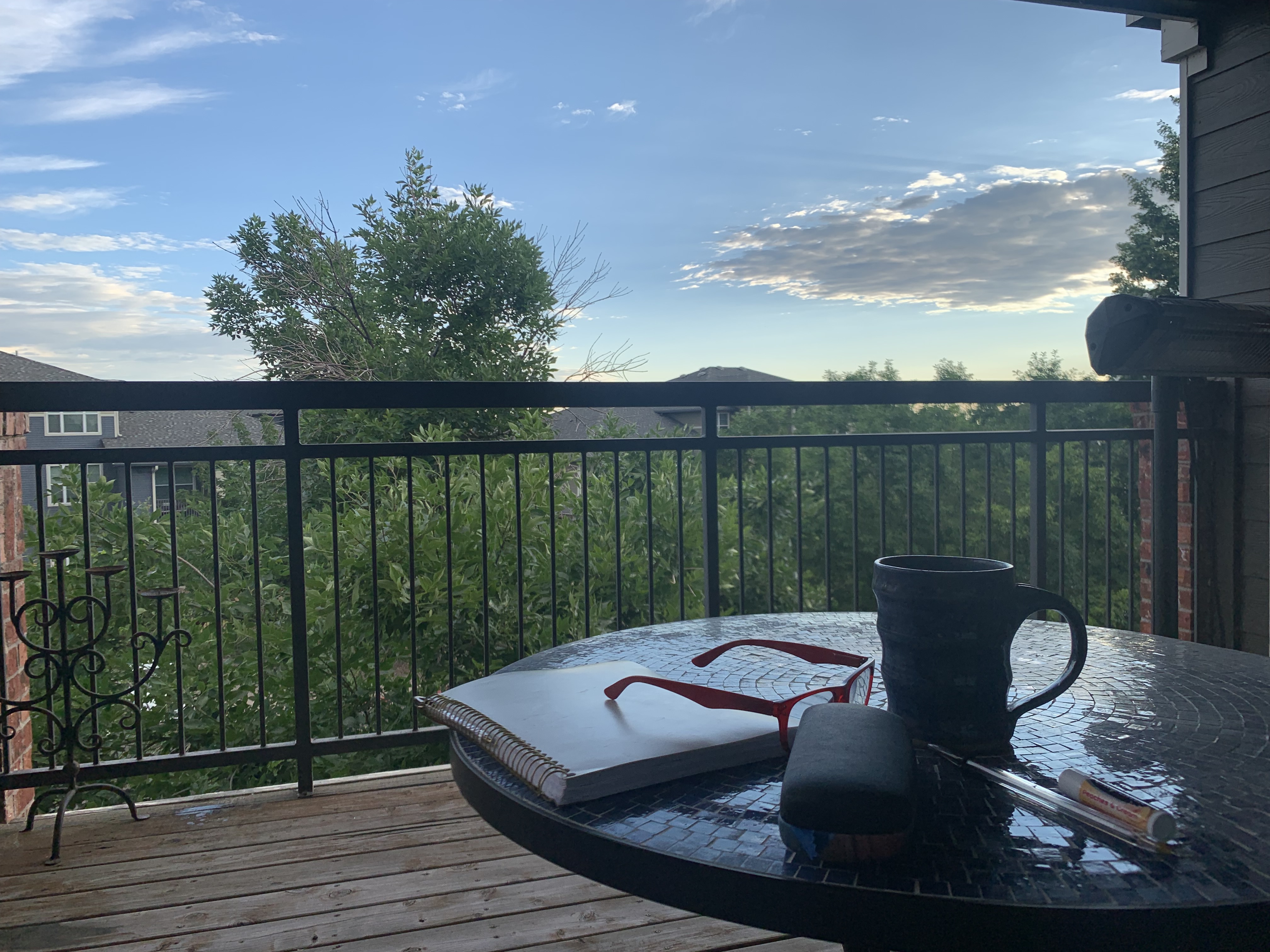
So today, July 28, 2022, I’m writing at 8 am on my beautiful shady balcony. Two months from now, mornings on the balcony will be a much darker, much chillier affair, and 4 months from now it will be impossible. Summer mornings on the balcony are special and fleeting, so for the next month I will fully enjoy my 8 am writing on the balcony time.

Even a few weeks of a productive routine is a gift. So establish and enjoy the short-term routine that will serve you today and embrace the ever unfolding kaleidoscope that is a long-term writer’s life.

You got this!
xoxoxo Nancy

On Finding Inspiration: Holy Boredom

I’m bored the kids whine as soon as summer begins. Boredom seems bad. And it’s so easy to fill the empty spaces with a million easy-to-reach options: from food to electronics to conversation. “If you have time to lean, you have time to clean!” say the Ghosts of Restaurant Managers Past. Empty time seems wrong somehow.

But let me suggest, after putting it to the test myself, that the real key to finding inspiration no matter where you are is a healthy dose of Holy Boredom.

I’m writing to you now at the end of my sabbatical. (After 10 years of teaching college I decided that I was giving myself my own sabbatical!) And I’ve discovered that even on sabbatical, once the initial excitement wears off, it’s easy to get bored. My budget wine-cellar-turned-apartment has no television. Internet is spotty and unavailable altogether once I leave my apartment. But it took me about a week to discover this because, of course being someplace new makes you want to walk, explore, snap pictures. Which is why inspiration, real inspiration, did not arrive for me until week 2, when I’d explored all the crannies, eaten at all the restaurants, took all the pictures, and finally found boredom.

Holy Boredom—that place of nothing-ness where everything already lives.

beach crop

My guru is always (gently) reminding me that I need to meditate. I try. I have an app. I schedule it in my normally busy schedule, in between A and B. But the real point of mediation, as I understand it, is to quiet the mind, to silence the honking horns of urgency.

Holy boredom is to creativity what meditation is to the mind. Intentional stillness. Wide open space with no agenda. We think we’re so busy because the outside world is always pushing down on us (insert job, obligations, etc.) But also we do it to ourselves. We keep our mind busy, spinning, distracted. it’s not until you reach a place of actual boredom that inspiration, that deep inspiration, can shyly arrive.

So it’s not the table with the view by the sea that creates the inspiration—it’s the wide spaces of nothingness you create around the table. Staring out a window with no agenda. A long silent walk (with no phone). Room for boredom without the usual distractions: music, television, conversation.. It’s from that deep stillness your most original ideas can finally bubble to the surface.

As a disciplined person, one who normally uses all time available with military precision, scheduling in boredom seems, well, silly. But the good news is that this can happen here, now: you don’t have to travel anywhere to create pockets of holy boredom—they already exist, we just fill them so fast we don’t even see them: whoosh! Gone. So this summer, if scheduling “writing time” seems too intimidating or exhausting, why not just make room for a bit of daily boredom in those spots that you usually fill with blur and noise and see what bubbles up instead?

To Your Success!

PS: Maybe find a Boredom Buddy to keep you accountable?

PSS: Tell me how it goes!