Flash fiction is changing the way we tell stories. Carving away the excess, eliminating all but the most essential, flash fiction is putting the story through a literary dehydrator, leaving the meat without the fat. And it only looks easy.
Veteran writer, publisher, and teacher Nancy Stohlman takes us on a flash fiction journey: from creating, sculpting, re-visioning and creating books of flash, to best practices for writers in any genre. If you’re already a flash fiction lover, this book will offer new inspiration. If you teach flash fiction, you’ll want this book as part of your repertoire. And if you’re new to the form, you might find yourself ready to begin.
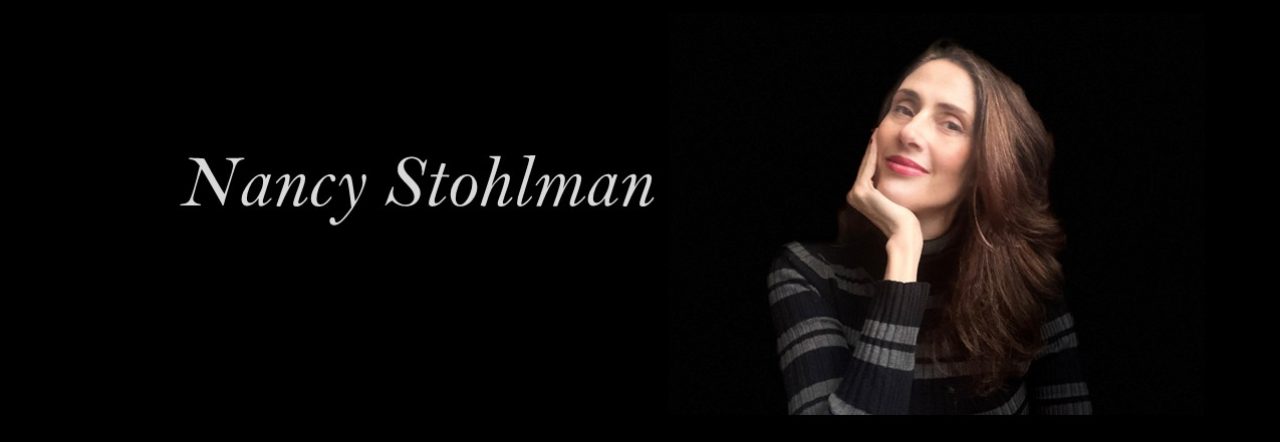
Nancy Stohlman has been a writer, editor, publisher, and professor of flash fiction for more than a decade. She has published multiple books of flash fiction and flash novels including Madam Velvet’s Cabaret of Oddities (a finalist for a 2019 Colorado Book Award), The Vixen Scream and Other Bible Stories (2014), and The Monster Opera (2013).
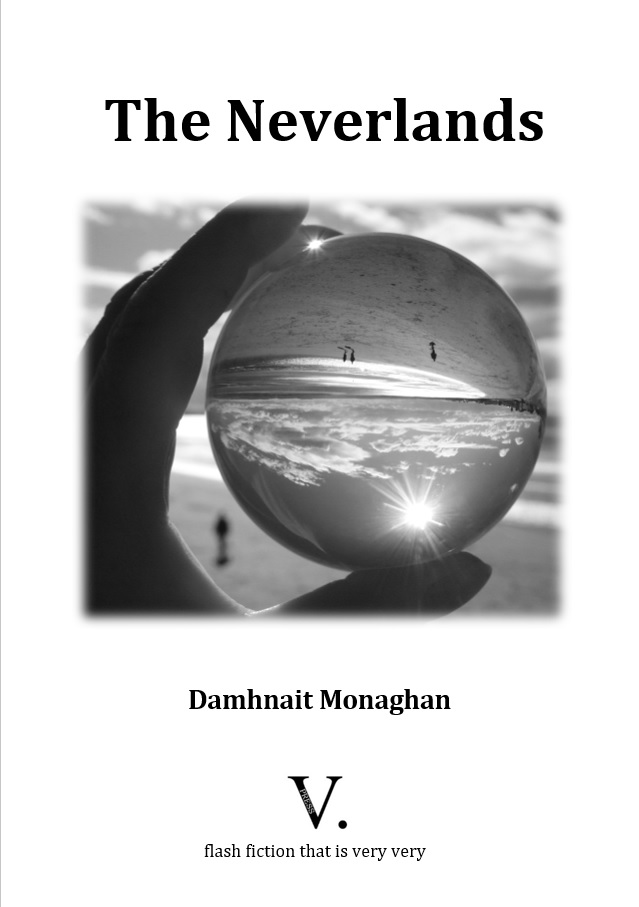
A deceptively slim book that tells an entire Irish family saga, Damhnait Monaghan’s debut, The Neverlands, is a beautiful treatise on who we love and how do we love–especially those closest to us. In this story love is vulnerable and risky…but it is also redemptive. A stunning mini epic full of equal parts sorrow and hope, each tension-filled story stands alone and yet together they create something powerful and universal.
NS: I love your opening story—the spray-painted phrase “Seamus O’Riordan is a gobshite” sets the tension and tone for me immediately. Was this story always the opening story? Or did this tale begin elsewhere for you?
DM:The Neverlands began as a mosaic flash written during Fast Flash, an online writing group led by the inimitable Kathy Fish, and was published at Jellyfish Review. A shorter version of the opening story was the first micro in that mosaic flash. It seemed a good place to begin the novella-in-flash as all three family members – Mammy, Nuala and Da – are referenced.
NS: How did the stories find their order—were they written mostly chronologically or did you mosaic around an idea?
DM: The five mini-micros in the original mosaic flash covered a lot of ground. Writing the novella-in-flash provided the opportunity to slow things down and fill in some of the bigger gaps between the original micros. I was vaguely aware of the overall arc I hoped to achieve, but I didn’t write the new stories chronologically, instead writing around images and ideas which then inspired more pieces. For example, I wrote a flash about Nuala’s holy communion ceremony where Mammy cuts down her wedding dress for Nuala. This led me to write a flash about Mammy and Da’s elopement, where Da shows up with that wedding dress.
NS: The title of the book, The Neverlands, comes from a literal misunderstanding of “The Netherlands,” but of course it’s a beautiful mistake. In some ways, “misunderstandings” both beautiful and painful are a defining feature of this epic story. Your thoughts?
DM: Yes, I think Nuala in particular misunderstands things that occur, partly because she wants to believe. For example, in ‘Holy Communion’ she half rises out of her seat to go look for the money tree in the garden that will pay for a new dress; she wants to believe in that money tree. But Mammy too makes mistakes; in “Star-crossed Lovers’ she runs off with Seamus/Da at sixteen, thinking his flattery is “dead poetic.”
NS: Your characters are Irish, and most of the story takes place in Ireland, but Ireland feels almost like a translucent background that you see in hints only. In the same way, I love how you pepper the Irish dialect without having it intrude on the story (as some written dialects can). What are your thoughts around writing in dialect?
DM: My parents were Irish, but emigrated to Canada before they married. I’ve never lived in Ireland (although I have visited) so I was over the moon when the wonderful Nuala O’Connor described the dialect in The Neverlands as ‘pitch-perfect.’
Done well, dialect adds another layer to a story, but I’ve read books where the dialect is so dense it’s off-putting (naming no names). I’m in the midst of dripping more dialect into the manuscript of my first novel, which is set in Newfoundland. I’m looking for that balance between a desire for authenticity and the need for clarity.
NS: At some point the child Nuala wants to stay and watch grandpa whittle, “wishing she could see what animal crawls out of the wood today.” I think your writing is a bit like this— you do an amazing job “carving” to the essence of each story. Talk about your writing process? Do you do a lot of editing/whittling or do they come out in big chunks? Or something else?
DM: Flash can be distilled right down to the essentials of the story. When I’m writing flash, I tend to write big, then pare down, changing words, tense, etc to polish the piece. The Neverlands underwent a fair amount of editing, as I explain below, and I was conscious of the need to ensure that each individual piece worked towards the whole, as well as the need for continuity.
NS: I really love the scene with the teabag—anyone who has traveled internationally will relate to being faced with unfamiliar and/or losing familiar cultural rituals. In your hands I felt this story as a point of compassion: being an immigrant is hard in hundreds of small ways (we usually only think of the big ones). Your thoughts?
DM: Thank you and yes, as an immigrant myself I agree that small things matter. When I first moved to the UK from Canada, I thought everything would be so easy. I figured, you know, Canada is a former British colony, we speak the same language, how hard could it be? Ha. There were myriad small differences that made day to day life incredibly frustrating in those early days.
As the daughter of immigrants, I so regret not quizzing them more about their culture shock -imagine their first winter in northern Canada! – while I still had the chance. The tea bag scene is based on a story my mom liked to tell about her first encounter with a teabag. During a layover in New York, en route to Canada, she had tea in a restaurant with her friends and they all had to take instruction from the waitress on how to “work” the tea bag.
NS: You use both Mammy and Nuala as story “headings.” It’s a simple strategy, but it works. How did you decide to do it this way?
DM: That was a suggestion made by my wonderful editor and publisher Sarah Leavesley at V Press. As there are two different voices in the novella, I think it helps to quickly ground the reader.
NS: The Neverlands is currently called “short fiction”—it could just as easily be called a novella in flash. Why one and not the other? And does it matter?
DM: Great question. At the time of publication, I was hung up on the apparent need for each flash in a novella-in-flash to be stand alone and wasn’t sure if all of mine did. (although reviewers seem to think they do.) But now, I think, why do they all have to be stand alone? Who made that rule? What is a novella-in-flash? It’s a short novel told in flash. If I was publishing it now, I would absolutely call The Neverlands a novella-in-flash. (Phew, glad to get that off my chest!)
NS: Ha! Now this is your first book—congratulations! Talk about V. Press and/or your road to publication?
DM: Thank you! The whole process was a delight, which I understand is not always the case in publishing. I met Sarah Leavesley of V Press at the 2018 Flash Fiction Festival and discovered they were open to submissions for flash pamphlets. At that point all I had was the original mosaic flash and another flash called ‘Habits’ written in that same Fast Flash course. The original mosaic was in Nuala’s voice and ‘Habits’ was in Mammy’s.
Well, it seemed these two characters had much more to say. While still at the Flash Fiction Festival I attended Karen Jones’ visualisation workshop (highly recommended). I was prepared to go wherever the visualisation took me, but allowed myself to hope it would be towards Mammy or Nuala. It was. The words flowed into rough drafts which I polished, later submitting a sample to V Press. Sarah got in touch to request the full MS and subsequently offered me publication. We then spent some time to-ing and fro-ing on edits until we were both happy with the final result. I can’t praise Sarah enough. She is a fantastic editor and also designed my gorgeous cover.
NS: Advice for writers who are writing a book?
DM: Oof. There’s so much advice out there, much of it conflicting. Do what works for you. Find your tribe, be it online or in person. For me, literary Twitter has always been a brilliant and supportive writing community, but there are lots of other avenues. Find what works for you. Don’t compare yourself to other writers and celebrate their success as much as your own.
NS: Anything else you want to add?
DM: Just to thank you so much for this opportunity to chat, Nancy. I’m sad we won’t see each other again this year in Bristol, but will cross my fingers for 2021!
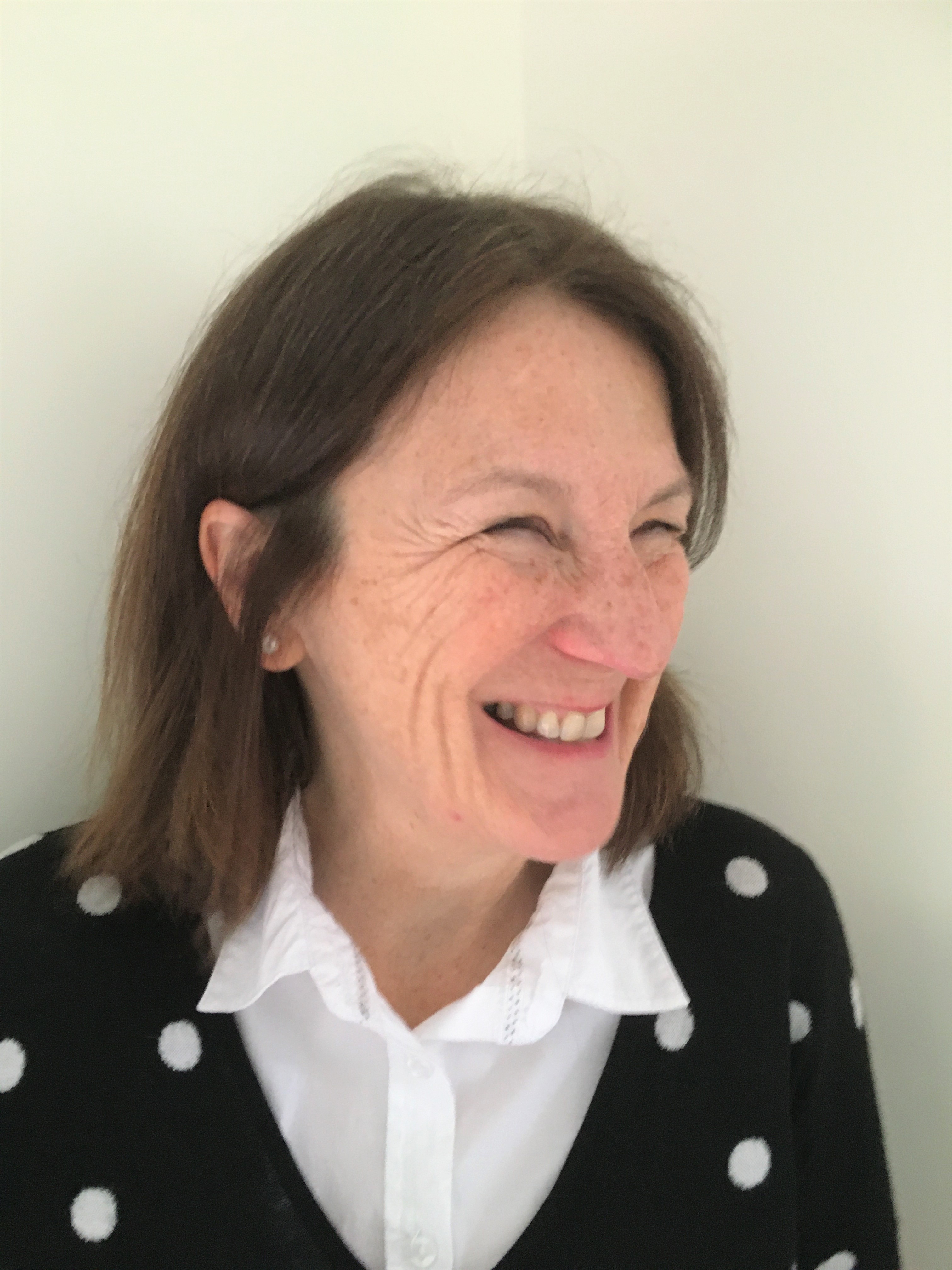
Damhnait Monaghan was born and grew up in Canada but now lives in the U.K. Her writing has won or placed in various competitions and is widely published and anthologised. She has been nominated for the Pushcart Prize, Best Small Fictions, and Best Microfictions. Her novella in flash The Neverlands was published by V. Press in 2019. She is an editor at FlashBack Fiction, an online literary journal that showcases historical flash fiction. You can find her on Twitter @Downith.
I am sending you lots of love in such a difficult and uncertain time. I’ve been thinking a lot about the painter, Mark Rothko, who said that abstract expressionism really came as a result of artists needing to say something that had never been said before. Basically, when the world changes, art changes.
So in all this uncertainly, there is something you can do: make art. The world needs artists more than ever in times of crisis. We are the visionaries. I’ve always said that I have no idea how the non-artists in the world handle their emotions! If I couldn’t journal, write, sing…I don’t know what I would do. We are lucky. We have our art.
So to that effect, Kathy Fish and I are going to do a morale-boosting, free 30-day FlashNano-like event starting tomorrow, Monday, March 16, for everyone sitting home in front of their computers and ready to write. We’ll be posting daily prompts (many recycled from FlashNanos of years past or from our retreat “prompt envelope”) on our website (no need to sign up for anything, we are just going to keep it simple), so we hope that this strange time can also be productive and inspiring.
We can’t control the crisis but we CAN control what we do. So let’s make some art. Please be safe and stay healthy and look after each other.
xoxoxo
The stories in Kim’s Chinquee’s new collection, Wetsuit, are the barest of wisps, impressionistic in their minimalism and yet dense with implied meaning. Each one is a gem, deceptively simple but hiding entire, barely concealed worlds in the silences. With each revisiting you discover the truth: that the stories are shadowboxes that continue into infinity, a magician’s hat with no bottom.
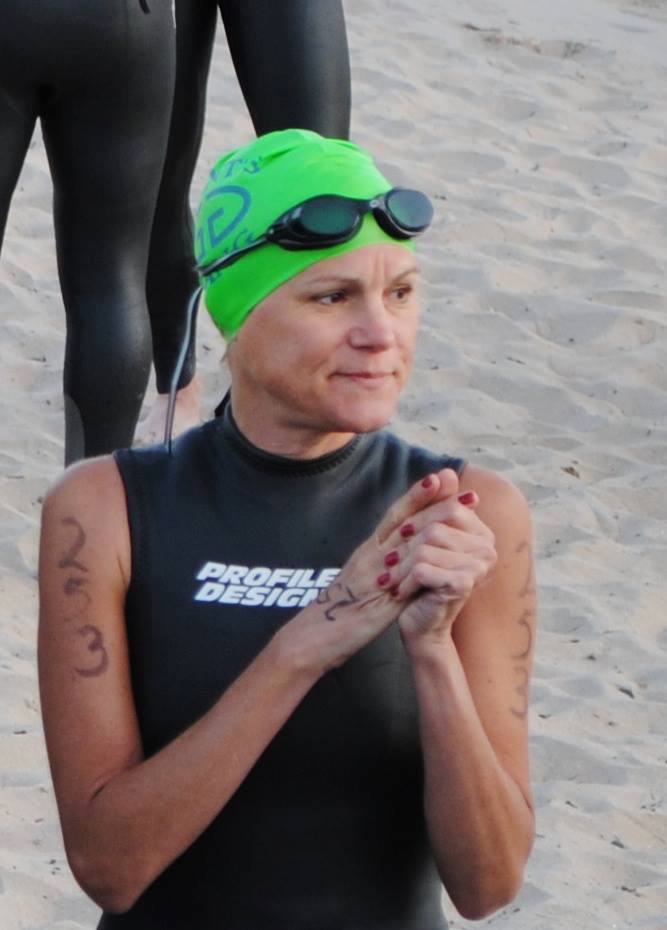
Photo by Diane Sardes
Nancy Stohlman: In the spirit of flash fiction, explain this book in six words:
Kim Chinquee: Water. Swimming. Food. Animals. Motherhood. Men.
NS: I’m super intrigued by your titles, which are very often a seemingly random phrase pulled from the story that becomes the title and then suddenly isn’t random at all. Talk about your process with titles. Does it change the story for you?
KC: Absolutely! Titles are so much fun. A title can inform a piece, and can also turn it on its head. I’m always experimenting with titles, whether removing the first sentence of a story, and using it as a title. Or sometimes I’ll choose the last sentence, or one from the middle. Or perhaps the title is a word in the story that repeats itself. When I studied with Mary Robison, she recommended (to me and other students) closing our eyes and randomly pointing to places (on the physical copies of) our stories and opening our eyes and imagining the words and phrases (where our fingers landed) as potential titles. That’s a fun exercise I share with my students a lot. Sometimes a title can have nothing to do with the text of the story and can give that entire piece a different meaning. I think I have a few stories with titles like that.
NS: Your stories are very sculpted—sometimes down to almost an impressionistic wisp. I often find myself rereading them several times, as they are slight but extremely dense, sometimes deceptively so. How do you know when to stop? Do you think flash writers ever go too far?
KC: It’s possible to go too far, of course. But one can always save the latest drafts and rearrange the words, add them back, etc. I struggle with writing longer work because I’m always cutting.
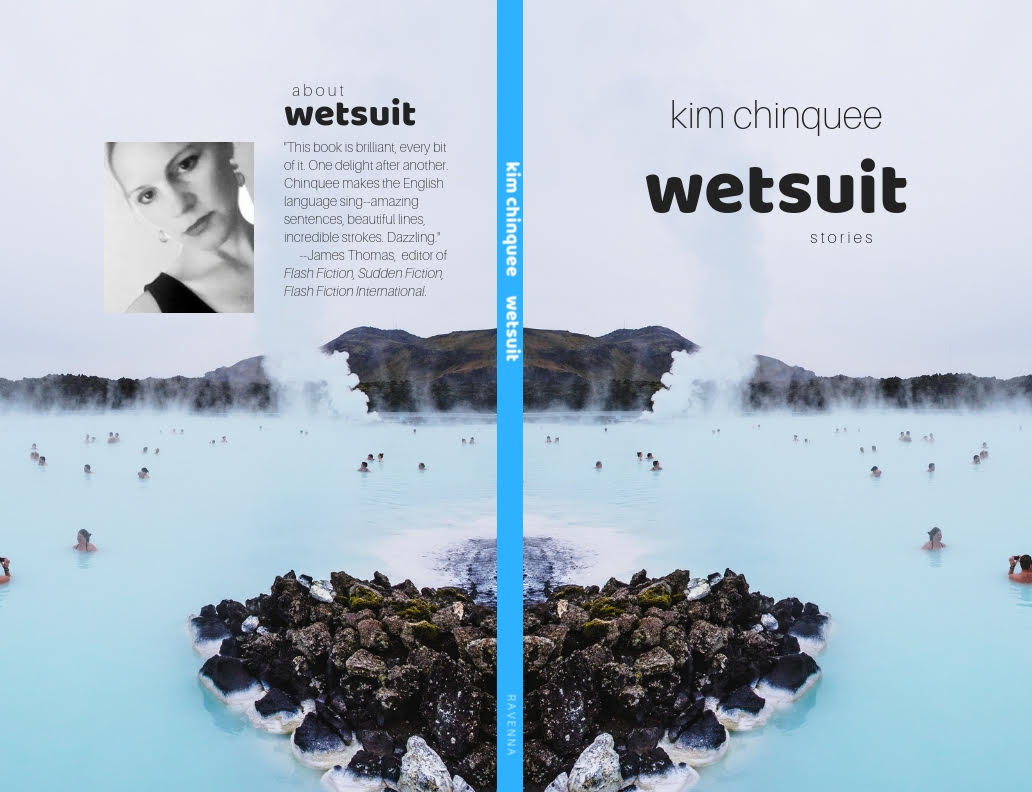
NS: Water is a theme connecting these stories, from puddles to steam to oceans to ice. Talk about your connection to water and why it ripples through this book? (By the way I love your picture of Iceland’s Blue Lagoon on the cover!)
KC: Thank you! Pier Rodelon designed Wetsuit (and my books Oh Baby, Veer, and Shot Girls). And (in speaking of titles): I had several other titles of the book before deciding on Wetsuit (I think maybe MILK was one.)–and when I saw the cover, I realized Wetsuit was the one that best “suited,” and included mostly pieces pertaining to liquid and/or water of some form. And I added some words and lines to some of the pieces so they would better fit the overall theme. So, the theme of water was kind of accidental, I suppose. Or something that I didn’t see until later. I had been swimming a lot and doing triathlons when I was writing these pieces, so it makes sense to me now that I was writing a lot about water.
NS: The narrator seems consistent through many of the stories, and we get reoccurring images tagging back to other stories. Was this an intentional weave or a happy discovery? And if intentional, how you would distinguish this collection from, say, a flash novel? Or is it?
KC: It probably was a bit of both intentional weave and happy discovery. Some of these pieces were written long ago, and some were written during the same timeframe and in consecutive order. When compiling the collection, I ordered them to have some sort of arc, and/or storylines that connect and speak to each other.
NS: On that note, your beginning and your ending are also circular, with one image from the end hooking up with the initial one. It gives a certain sense of spiraling around and around a life. Can you about your circular concept?
KC: Thanks for noticing that! My editor and publisher Kathryn Rantala suggested ending on that last piece “My New Skin,” which I thought was kind of brilliant. I suppose, when looking at it now, I like to think it’s a metaphor for the front crawl or the breast stroke, the circular motion and the constant movement that keeps one not only moving forward, but afloat.
NS: About 2/3 of the way through the book your stories start to get super short and extremely dark. It feels like both a shift, a deepening, a quickening, and also, consequently, like the climax of the book. Can you talk about your design and intention with this purposeful pondering?
KC: As I was compiling the collection, it seemed natural to me to put these pieces closer to the end of the book, I suppose like a climax. I was afraid that if I included them near the front of the collection, they might discourage the reader, and that some content before might give them more context. I suppose it’s a lot like writing a novel. Wetsuit feels, content-like, or at least the way I compiled it, much like how I put together my first collection, Oh Baby.
NS: You have been an important voice in the flash fiction movement for a long time, and you’ve authored many books, including Shot Girls, Pretty, Veer, and Oh Baby. How is this book different than your others?
KC: Ah! Good question. I was about to talk more about this in the previous answer. I like to think Wetsuit holds a bit more hope for its main protagonist, and that there is maybe more maturity and depth. The son of Wetsuit is older, an adult, and there is a longing, I think. Artistically and aesthetically, Wetsuit is much like Oh Baby, imo. Veer was compiled as a collection to celebrate the venues where the pieces appeared (and where I’ve published most regularly): NOON, Conjunctions, Denver Quarterly, Willow Springs, Story Quarterly. Pretty was published (as a prose poetry collection) with White Pine Press, under different editorship and is told in three parts. Whereas Shot Girls (also with Ravenna Press) includes mostly longer stories, of women working in “service,” including the military, and it includes a few flashes.
My next collection will also be published with Ravenna Press in 2020! It’s tentatively titled Snowdog. (And involves a lot of snow. And dogs.) Though I tend to change my titles a lot!
My novel-in-flashes, Battle Dress, will be published with Widow + Orphan House in 2021. I wrote the pieces in Battle Dress in consecutive order, while I was running a lot of local 5K, 10K races. So, there’s a lot of running and repetition in that book. Kind of like running the same kind of races (with different results) over and over.
I’ve also written a couple of “non flash” novels, and am currently revising Pirouette, which takes place in Boston, with alternating points-of-view of three protagonists and their experiences during the Boston Bombings. I’ve also started a new book called Stray Voltage, which is mostly about cows.
I probably write flash fictions with the most consistency and frequency, especially when I’m in the midst of teaching and doing administrative work. So, when compiling Wetsuit, I drew upon the flash fictions in my inventory, and put them together in a kind of collage.
NS: Congratulations! I’m looking forward to all of these! Wetsuit is published by Ravenna Press. Talk about your path to publication?
KC: Ravenna Press published my first book Oh Baby in 2008; I had such a great experience with Ravenna, and continue to publish with them. Kathryn Rantala is a great advocate and supporter of my work. I believe we have a mutual respect for each other and I love working with her.
NS: What advice would you give someone who is writing/wants to write a book?
KC: Read a lot. Write your story. Collect advice and keep what’s useful. Pay attention to what’s happening around you.
There’s a new review of Wetsuit available at Rain Taxi:
Kim Chinquee is the author of six books, most recently WETSUIT. She’s the recipient of two Pushcart Prizes, and serves as AWP Northeast Regional Chair. Her website is www.kimchinquee.com
 Nancy Stohlman