
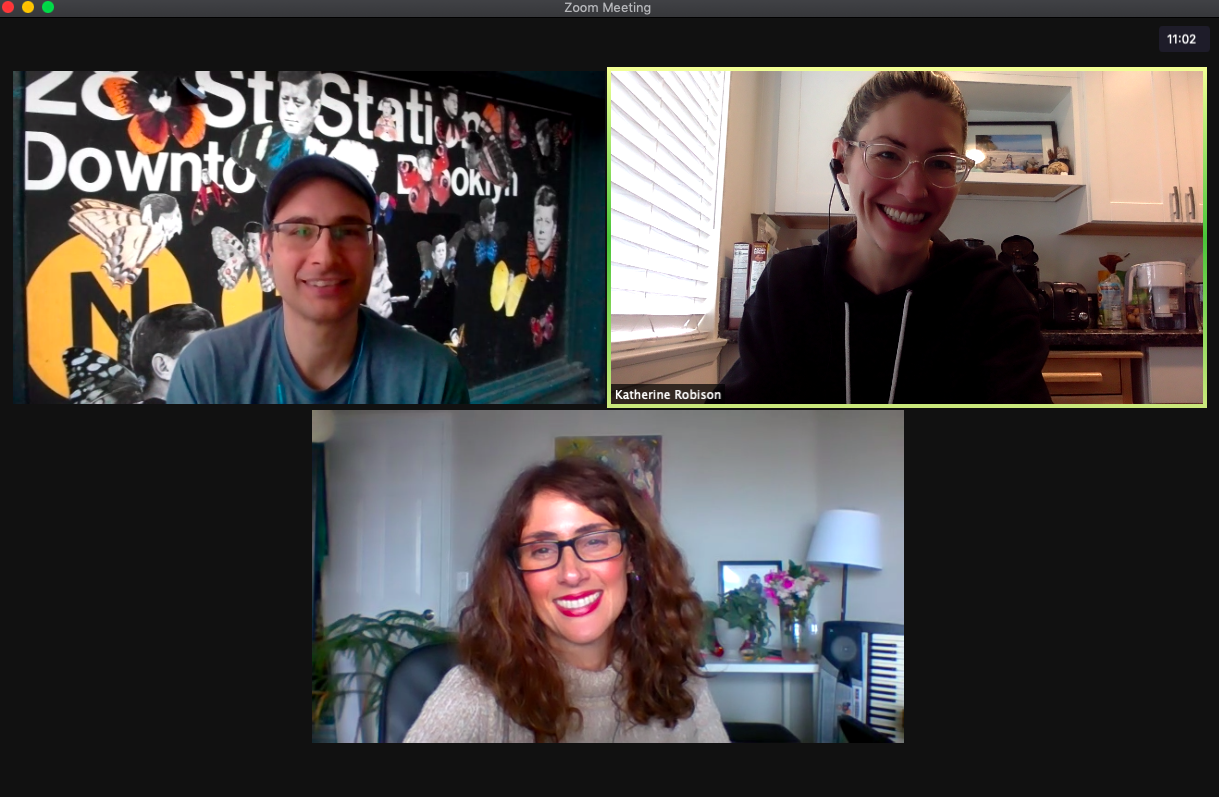
Dan and I went to graduate school together at the Jack Kerouac School for Disembodied Poetics (I try and say that name whenever possible!) many moons ago, and I’m so proud of all he’s been doing with this Podcast. We first recorded in 2020 during the pandemic when Going Short was first released–and last year we reconnected to talk about how the book–and the new audiobook–had been making friends out in the world. Have a listen–we had so much fun chatting xo


PLAY EP.101 NOW! 101. Growing Flash Fiction w/ Nancy Stohlman
Dan invites Nancy Stohlman back on Writing Remix to discuss recording the audiobook for her award-winning book Going Short: An Invitation to Flash Fiction, the growing genre of Flash Fiction, the importance of building a creative community to recover from burnout, doing promotion for her book during COVID-19 quarantine in 2022, and so much more.
This episode was recorded on April 20th, 2022.
Read and download the full transcript of this episode at writingremix.com.Nancy Stohlman is the author of six books including After the Rapture (2023), Madam Velvet’s Cabaret of Oddities (2018), The Vixen Scream and Other Bible Stories (2014), The Monster Opera (2013), Searching for Suzi: a flash novel (2009), and Going Short: An Invitation to Flash Fiction (2020), winner of the 2021 Reader Views Gold Award and re-released in 2022 as an audiobook. Her work has been anthologized widely, appearing in the Norton anthology New Micro: Exceptionally Short Fiction and The Best Small Fictions 2019, as well as adapted for both stage and screen. She teaches at the University of Colorado Boulder and holds workshops and retreats around the world. Find out more at http://www.nancystohlman.com
A Note From Dan
“You know, we can study a text on the page. We can reverse engineer it. We can break it open. We can mimic it. We can do all these things, but I think listening to it through the ear just kind of brings in a whole other host of body wisdom.”
-Nancy Stohlman
The body is an abundance of scars, memories, and wisdom. We store this knowledge in plain sight of the public, sometimes. We hide them from being exposed. We even share these things with people closest to us in the middle of the afternoon, when it feels right to turn the rest of the world off and all that matters is to bare it all.
Wisdom is the body. It’s ephemeral. It’s infinite. It’s language. It’s creation.
When I write, I pull from the wisdom stored in my body. I journey along trying to locate where I’ve filed away the ideas I need to finish a sentence or complete an thought on a podcast, or even a long simile for a poem.
Nancy Stohlman remixes what the interconnected relationship between the page and audio. She considers the role of the body, the energy a piece of writing had when it was written, and the transformation of its energy in the immediate moment of reading it out loud.
Our body is a filtration system. Our breath mixes together syllables and words with our personal rhythms, much of which is hard to replicate in a written sentence, because our patterns change with time.
Nancy talks about recording the audiobook as creating a new text for a particular audience of auditory learners, “I think that’s really what the audio books do, in some ways it’s cross pollinating a whole other form and bringing in a whole different sort of reader” (Stohlman). The audiobook has it’s own nuances and complexities. Because the body is so much more part of the process, it’s strenuous in a way writing isn’t, and accepting this provides the body-wisdom needed to successfully create an audiobook.
She discusses about the mind, body, and spirit prep she had to go through, what sort of strategies were told to her to protect and use her voice correctly, how the recording process went, and what it was like to revisit her book after so much time had passed since its publication.
As a podcaster, this episode was a huge learning experience, because I take my actual voice for granted. I can’t tell you the amount of times I’ve lost my voice to the point where I couldn’t even whisper. As a writer, I never think of my bodily voice I’m always talking about writing voice. Yet, so much of my scholarship is audio and done with my voice and I take for granted being able to engage in day-to-day conversations. I burn my voice out.
I know I need to dedicate myself to body wisdom, to listening to my body when it’s tired, to know it’s okay to rest, and to physically strengthen my body. At the same time, I know I must collect the wisdom hidden in my body, that wisdom I pushed aside for mind wisdom, disembodying myself from a lineage of knowledge, and ultimately cutting myself off from my spirit.
There’s so much in this episode! I hope you get as much out of it as I did. Please email me your thoughts on body wisdom, or about anything you heard in this episode to writingremixpodcast@gmail.com and I’ll share it on a future episode! Make sure to Leave a 5-star rating and a review wherever you’re listening, and please follow and share the podcast.
Episode 101 Reflective Questions
This week’s Reflective Questions ask us to consider the value of Body Wisdom.Make a list of all the places on and in your body you hold and/or hide wisdom.
Take 15-minutes to write about the how you experience body wisdom. This can be a question of what it might feel like to tap into that body wisdom, or what it feels like to search for it, or maybe what it feels like to create new body wisdom.
Write about a time where you listened to your body wisdom’s intuition. Why did you listen? How did that feel? What was the outcome?
Share your writing with me at writingremixpodcast@gmail.com, or post your thoughts on Instagram and tag the podcast @WritingRemixPod, and I’d love to read them on the next episode!
Quotes From Episode 101:
“I think that’s really what the audio books do, in some ways it’s cross pollinating a whole other form and bringing in a whole different sort of reader.”
-Nancy Stohlman
“You know, we can study a text on the page. We can reverse engineer it. We can break it open. We can mimic it. We can do all these things, but I think listening to it through the ear just kind of brings in a whole other host of body wisdom.”
-Nancy Stohlman
“So often, creative people create these artifacts, these great products, and then they freeze when it comes to, ‘how do I find the people that I wanted to talk to about this,’ and it all goes under this umbrella of promotion [and] self promotion. Yet, I think of it more as how do I find the people that I’m trying to serve? You know, how do I find the people that need what I’ve got? Because I made it for them. And if they don’t know that I have it, then neither one of us is winning here.”
-Nancy Stohlman
“I really wanted to, as you say, honor and validate the people who’ve been building the genre [of flash fiction] and speak to new people who are like, what is flash fiction”
-Nancy Stohlman
“Often I think when people are burned out, what they’ll do is they’ll take a class, right? […] But I can tell you as a person who offers many classes, there’s always some people who sign up and they never show up to the class. And I know that this is not because they’re forgetful. It’s because they’re burned out. They don’t really need me to give them homework, right? They don’t really need more exercises. What they need is to play [and] delight.”
-Nancy Stohlman
Order Going Short: An Invitation to Flash Fiction NOW!
Flash fiction is changing the way we tell stories. Carving away the excess, eliminating all but the most essential, flash fiction is putting the story through a literary dehydrator, leaving the meat without the fat. And it only looks easy.
Enter Going Short: An Invitation to Flash Fiction. In this, her treatise on the form, veteran writer Nancy Stohlman takes us on a flash fiction journey: from creating, sculpting, revisioning and collecting stories to best practices for writers in any genre. It is both instructive and conversational, witty and practical, and presented in flash fiction chapters that demonstrate the form as they discuss it. If you’re already a flash fiction lover, this book will be a dose of inspiration. If you teach flash fiction, you’ll want it as part of your repertoire. And if you’re new to the form, you might just find yourself ready to begin
Follow the link for more information! Order After the Rapture NOW!After the Rapture is a flash fiction hybrid book written at the intersection between flash fiction and the novel. A leader and innovator of the form, Stohlman fragments the long form narrative into the distilled intensity of micro and compressed fiction while still maintaining a larger story arc.
 Nancy Stohlman