IT’S HERE! Going Short: An Invitation to Flash Fiction pre-sales now open!
Nancy Stohlman answers your common and not-so-common questions about flash fiction.
Today’s question: Must flash fiction have a twist ending?
http://www.nancystohlman.com Nancy Stohlman is the author of Going Short: An Invitation to Flash Fiction (releasing October 15, 2020 from Ad Hoc Fiction) as well as multiple books of flash fiction including Madam Velvet’s Cabaret of Oddities (a finalist for a 2019 Colorado Book Award), The Vixen Scream and Other Bible Stories (2014), and The Monster Opera (2013). She is the creator of The Fbomb Flash Fiction Reading Series and FlashNano in November. Her work has been anthologized in the W.W. Norton New Micro: Exceptionally Short Fiction and the Best Small Fictions 2019. She teaches at the University of Colorado Boulder.
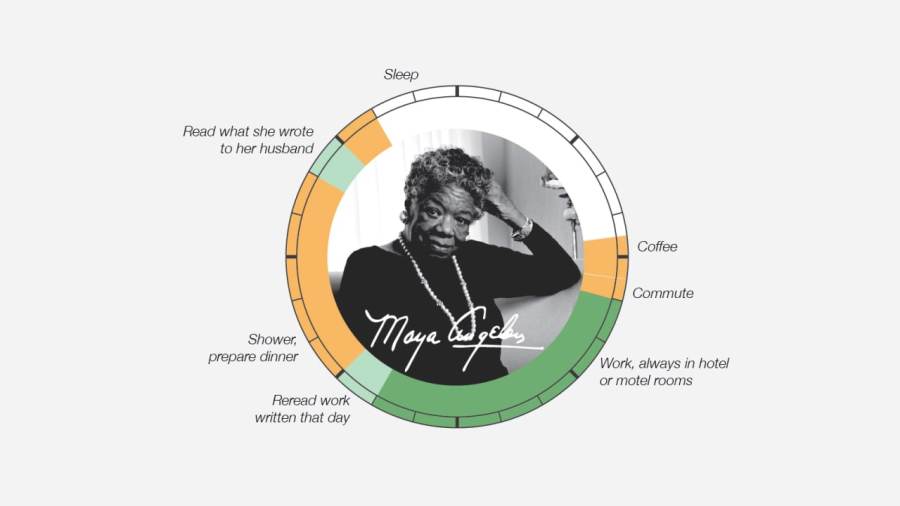
As summer approaches, and some sort of quarantine continues, there’s been plenty of talk of productivity and the joy of creating “schedules” to maximize our (creative) time.
But most of our lives look pretty weird these days. The days aren’t regular, but they’re not vacation, either. Many of our imposed schedules from the outside are gone, and we are finding ourselves floating in an immense and frightening freedom.
So the question is: how can we have both accountability and kindness for ourselves?

Now that my semester is ending, I’ve been asking myself this question a lot. I decided to do a little investigating into my stack of journals to see what my daily schedule looked like last summer when I was (both highly productive and) on sabbatical.
And that’s when I discovered something important: I didn’t have a schedule. I had a routine.
I realize this is an idealized routine, but the important takeaway is that because this was a routine and not a schedule, there were no set-in-stone times. I did NOT set the alarm to wake up at a specific time or say “I have to be at the coffee shop by noon” or whatever. Instead, the looseness of this routine vs a by-the-clock schedule meant that everything got done every day—but the daily particulars were flexible.

We all have many routines already. Consider: many of us wake up and then drink coffee. One thing naturally follows the other—we wake up, we make coffee, we drink it. I have never set my alarm to make sure I don’t miss drinking coffee–coffee is part of the routine.
Or: I read every night in bed before I go to sleep. Sometimes I read for an hour. Sometimes I read for 15 minutes. Sometimes it begins at 10 pm. Sometimes it begins at 11 or 8. I never have to schedule reading time because it always happens last in my daily routine.
Not looking at the clock works for me. Letting one thing naturally follow the other in a predictable sequence works for me. Creative work needs creative breathing room. And yes, it also needs discipline. But when we make schedules we can become militaristic—we beat ourselves up, lording the clock and the whip to do those 30 mins of yoga/meditation/writing by a certain time instead of honoring that we are dynamic animals in an ever-changing daily flow.
That’s why I think a routine is truly the sweet spot in the middle. Think of it as the “sliding scale” schedule, a sequence of events. Rather than “I must be at my desk by 10 am”, it can be: “I must go to my desk after coffee.”
That said, some things must be scheduled. Work, classes, events have a starting time that we may have to work around. But for all the rest of the time, especially with summer birthing itself and many of us yearning for more productivity in this strange, in-between time, I encourage you to get investigative: throw out the clock, listen to your your natural rhythm, and discover your perfect routine. When in the day are you the most productive? When do you want to rest? Do you wake up ready to write? Or do you like to wake up slowly? Do you like to take a nap? Stay up late? Take a walk in the evening or after working? See if you can create a routine that really supports that flow this season, rather than imposing a schedule that may be counter to what you (and your creativity) really need.
Remember: Even the bunnies stay out later in the spring, regardless of what the clock says.
Here’s to your perfect routine!
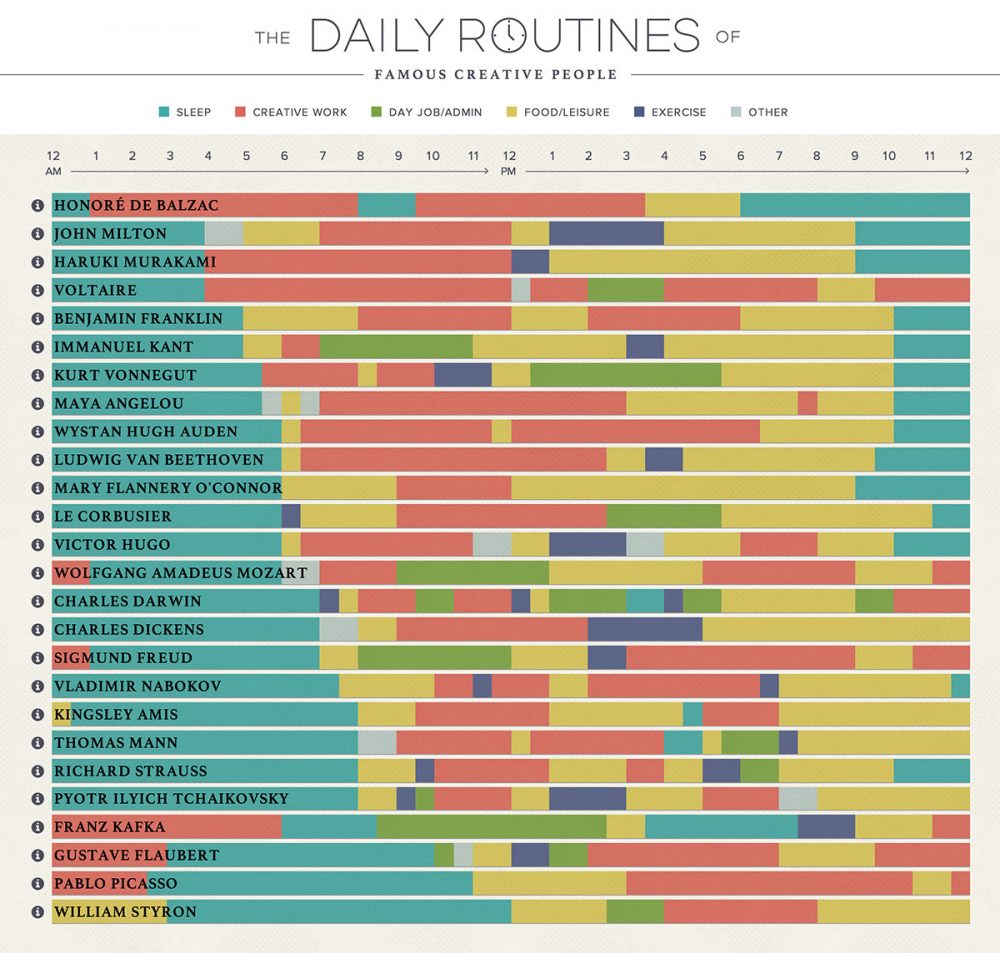
(and check out some of the surprising routines of creative people below)
xo
Nancy
___________________________________________________________
1. Writing Wild in the Blue Zone Retreat to Costa Rica has been….
Cancelled/Rescheduled!
The new dates are May 8-14, 2021.
The French Connection Retreat to France has been…..
Cancelled/Rescheduled!
The new dates are June 5-11, 2021.
The High Altitude Inspiration Retreat to Colorado has been…..
Cancelled.
Shadowcliff has closed the venue to groups for now.
The June release of Going Short: An Invitation to Flash Fiction from Ad Hoc Press has been….
Postponed!
This will likely come out in early 2021–stay tuned for a new release date.
Workshops: Not Cancelled!
In honor of my delayed book release I will be running a fun, 5-day “Going Short” Writing Flash Fiction (with preview chapters from the book) workshop from June 22-26 for those of you who want to get your pens moving. Registration opens soon.
And I’ll be running another Flash Flood: Write a Flash Novel course again in July. Read testimonials from past participants.
Stay sane out there, everyone!
A deceptively slim book that tells an entire Irish family saga, Damhnait Monaghan’s debut, The Neverlands, is a beautiful treatise on who we love and how do we love–especially those closest to us. In this story love is vulnerable and risky…but it is also redemptive. A stunning mini epic full of equal parts sorrow and hope, each tension-filled story stands alone and yet together they create something powerful and universal.
Nancy Stohlman: Describe this story in six words:
Damhnait Monaghan: Family. Motherhood. Habits. Loss. Change. Hope.
NS: I love your opening story—the spray-painted phrase “Seamus O’Riordan is a gobshite” sets the tension and tone for me immediately. Was this story always the opening story? Or did this tale begin elsewhere for you?
DM: The Neverlands began as a mosaic flash written during Fast Flash, an online writing group led by the inimitable Kathy Fish, and was published at Jellyfish Review. A shorter version of the opening story was the first micro in that mosaic flash. It seemed a good place to begin the novella-in-flash as all three family members – Mammy, Nuala and Da – are referenced.
NS: How did the stories find their order—were they written mostly chronologically or did you mosaic around an idea?
DM: The five mini-micros in the original mosaic flash covered a lot of ground. Writing the novella-in-flash provided the opportunity to slow things down and fill in some of the bigger gaps between the original micros. I was vaguely aware of the overall arc I hoped to achieve, but I didn’t write the new stories chronologically, instead writing around images and ideas which then inspired more pieces. For example, I wrote a flash about Nuala’s holy communion ceremony where Mammy cuts down her wedding dress for Nuala. This led me to write a flash about Mammy and Da’s elopement, where Da shows up with that wedding dress.
NS: The title of the book, The Neverlands, comes from a literal misunderstanding of “The Netherlands,” but of course it’s a beautiful mistake. In some ways, “misunderstandings” both beautiful and painful are a defining feature of this epic story. Your thoughts?
DM: Yes, I think Nuala in particular misunderstands things that occur, partly because she wants to believe. For example, in ‘Holy Communion’ she half rises out of her seat to go look for the money tree in the garden that will pay for a new dress; she wants to believe in that money tree. But Mammy too makes mistakes; in “Star-crossed Lovers’ she runs off with Seamus/Da at sixteen, thinking his flattery is “dead poetic.”
NS: Your characters are Irish, and most of the story takes place in Ireland, but Ireland feels almost like a translucent background that you see in hints only. In the same way, I love how you pepper the Irish dialect without having it intrude on the story (as some written dialects can). What are your thoughts around writing in dialect?
DM: My parents were Irish, but emigrated to Canada before they married. I’ve never lived in Ireland (although I have visited) so I was over the moon when the wonderful Nuala O’Connor described the dialect in The Neverlands as ‘pitch-perfect.’
Done well, dialect adds another layer to a story, but I’ve read books where the dialect is so dense it’s off-putting (naming no names). I’m in the midst of dripping more dialect into the manuscript of my first novel, which is set in Newfoundland. I’m looking for that balance between a desire for authenticity and the need for clarity.
NS: At some point the child Nuala wants to stay and watch grandpa whittle, “wishing she could see what animal crawls out of the wood today.” I think your writing is a bit like this— you do an amazing job “carving” to the essence of each story. Talk about your writing process? Do you do a lot of editing/whittling or do they come out in big chunks? Or something else?
DM: Flash can be distilled right down to the essentials of the story. When I’m writing flash, I tend to write big, then pare down, changing words, tense, etc to polish the piece. The Neverlands underwent a fair amount of editing, as I explain below, and I was conscious of the need to ensure that each individual piece worked towards the whole, as well as the need for continuity.
NS: I really love the scene with the teabag—anyone who has traveled internationally will relate to being faced with unfamiliar and/or losing familiar cultural rituals. In your hands I felt this story as a point of compassion: being an immigrant is hard in hundreds of small ways (we usually only think of the big ones). Your thoughts?
DM: Thank you and yes, as an immigrant myself I agree that small things matter. When I first moved to the UK from Canada, I thought everything would be so easy. I figured, you know, Canada is a former British colony, we speak the same language, how hard could it be? Ha. There were myriad small differences that made day to day life incredibly frustrating in those early days.
As the daughter of immigrants, I so regret not quizzing them more about their culture shock -imagine their first winter in northern Canada! – while I still had the chance. The tea bag scene is based on a story my mom liked to tell about her first encounter with a teabag. During a layover in New York, en route to Canada, she had tea in a restaurant with her friends and they all had to take instruction from the waitress on how to “work” the tea bag.
NS: You use both Mammy and Nuala as story “headings.” It’s a simple strategy, but it works. How did you decide to do it this way?
DM: That was a suggestion made by my wonderful editor and publisher Sarah Leavesley at V Press. As there are two different voices in the novella, I think it helps to quickly ground the reader.
NS: The Neverlands is currently called “short fiction”—it could just as easily be called a novella in flash. Why one and not the other? And does it matter?
DM: Great question. At the time of publication, I was hung up on the apparent need for each flash in a novella-in-flash to be stand alone and wasn’t sure if all of mine did. (although reviewers seem to think they do.) But now, I think, why do they all have to be stand alone? Who made that rule? What is a novella-in-flash? It’s a short novel told in flash. If I was publishing it now, I would absolutely call The Neverlands a novella-in-flash. (Phew, glad to get that off my chest!)
NS: Ha! Now this is your first book—congratulations! Talk about V. Press and/or your road to publication?
DM: Thank you! The whole process was a delight, which I understand is not always the case in publishing. I met Sarah Leavesley of V Press at the 2018 Flash Fiction Festival and discovered they were open to submissions for flash pamphlets. At that point all I had was the original mosaic flash and another flash called ‘Habits’ written in that same Fast Flash course. The original mosaic was in Nuala’s voice and ‘Habits’ was in Mammy’s.
Well, it seemed these two characters had much more to say. While still at the Flash Fiction Festival I attended Karen Jones’ visualisation workshop (highly recommended). I was prepared to go wherever the visualisation took me, but allowed myself to hope it would be towards Mammy or Nuala. It was. The words flowed into rough drafts which I polished, later submitting a sample to V Press. Sarah got in touch to request the full MS and subsequently offered me publication. We then spent some time to-ing and fro-ing on edits until we were both happy with the final result. I can’t praise Sarah enough. She is a fantastic editor and also designed my gorgeous cover.
NS: Advice for writers who are writing a book?
DM: Oof. There’s so much advice out there, much of it conflicting. Do what works for you. Find your tribe, be it online or in person. For me, literary Twitter has always been a brilliant and supportive writing community, but there are lots of other avenues. Find what works for you. Don’t compare yourself to other writers and celebrate their success as much as your own.
NS: Anything else you want to add?
DM: Just to thank you so much for this opportunity to chat, Nancy. I’m sad we won’t see each other again this year in Bristol, but will cross my fingers for 2021!
NS: You are so welcome, and yes, long live 2021!
Links to buy the book or other promo links:
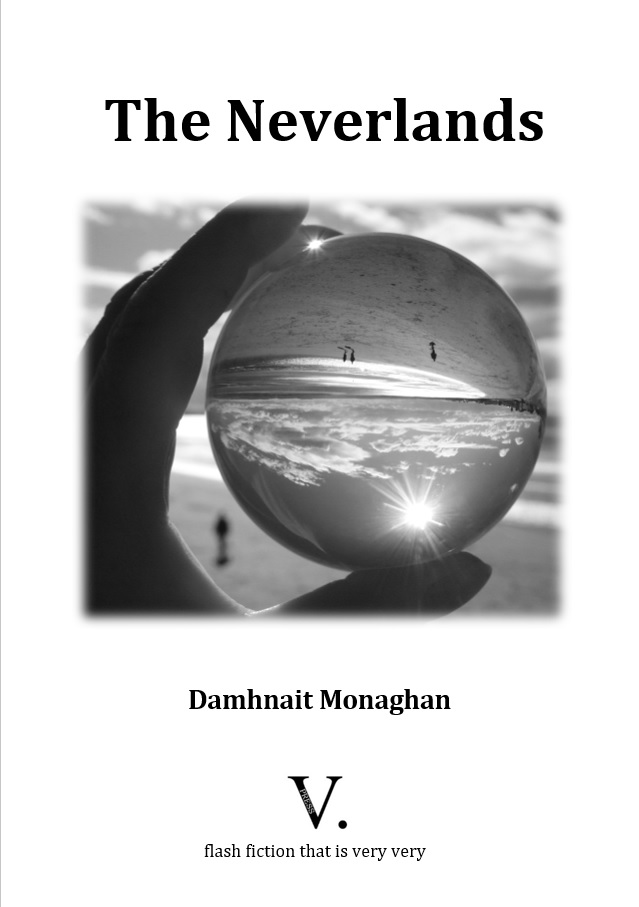
The Neverlands is in its second printing and can be purchased from V Press
Or for a signed copy, contact Damhnait direct via her website: www.damhnaitmonaghan.com
or on Twitter @Downith
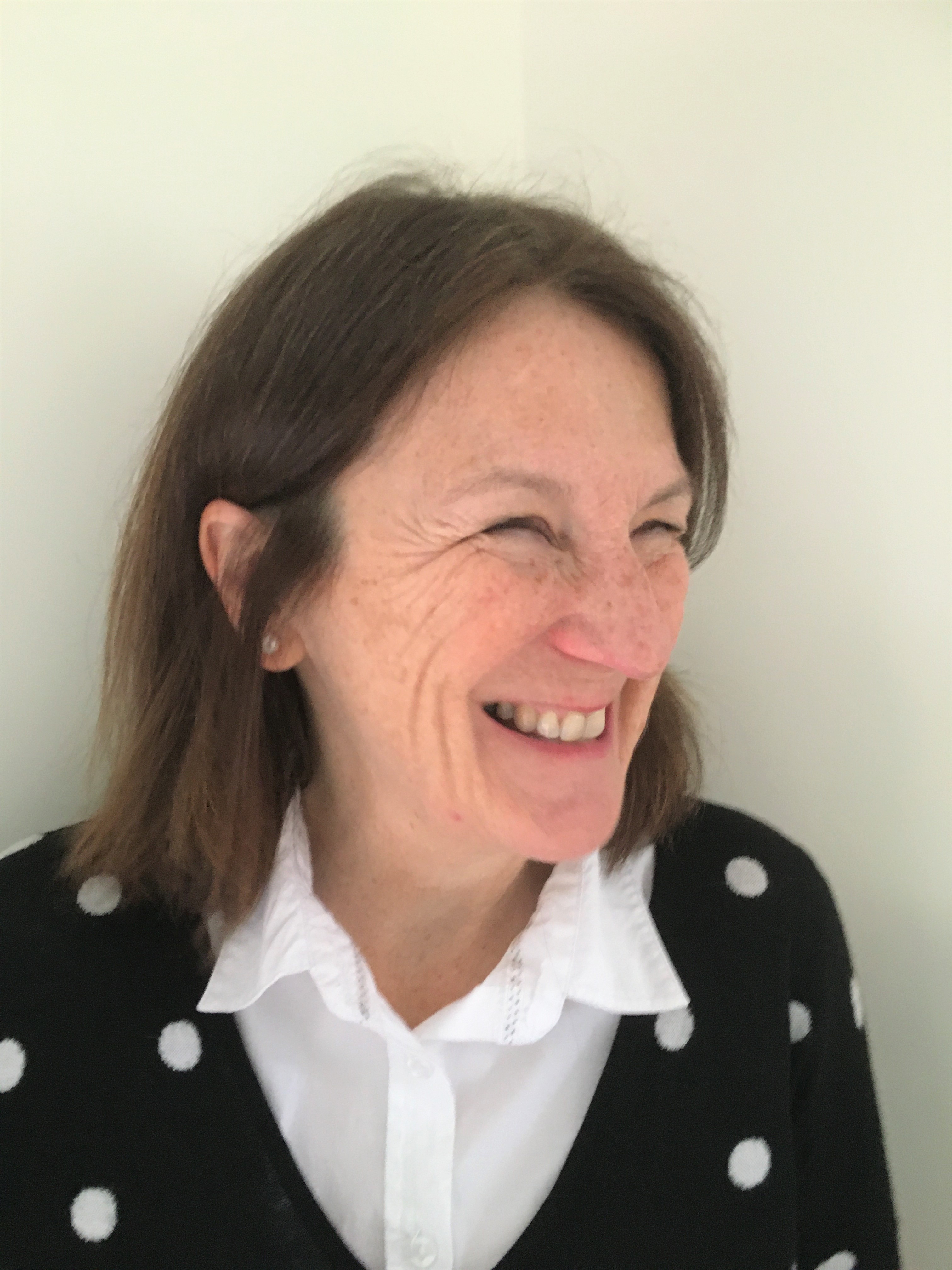
Damhnait Monaghan was born and grew up in Canada but now lives in the U.K. Her writing has won or placed in various competitions and is widely published and anthologised. She has been nominated for the Pushcart Prize, Best Small Fictions, and Best Microfictions. Her novella in flash The Neverlands was published by V. Press in 2019. She is an editor at FlashBack Fiction, an online literary journal that showcases historical flash fiction. You can find her on Twitter @Downith.
 Nancy Stohlman